

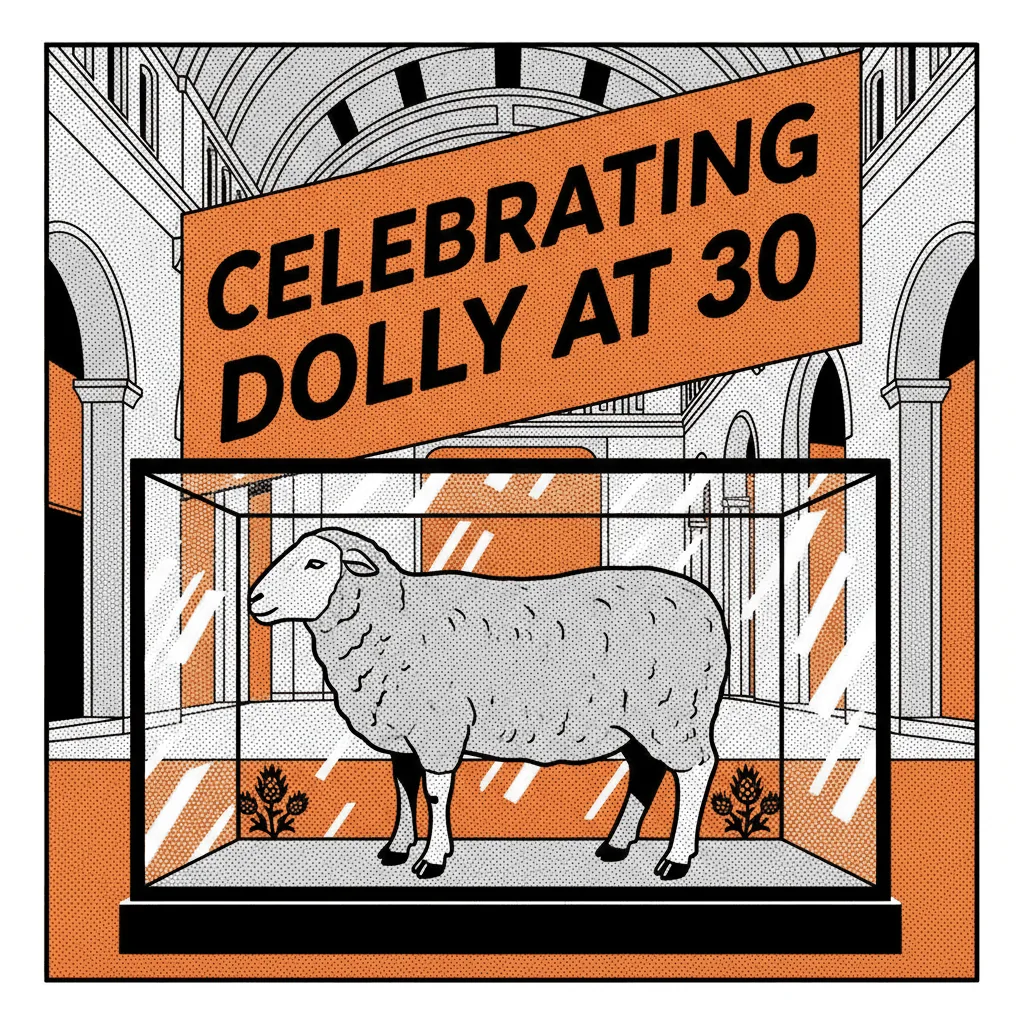
Thirty years ago, a team of scientists at the Roslin Institute in Midlothian did something that most of the scientific establishment said was impossible. They took an adult cell, reprogrammed it, and produced a living mammal: Dolly, the world's first cloned sheep from an adult somatic cell. She was born on 5 July 1996, announced to the world in February 1997, and she immediately became one of the most consequential animals in the history of science.
You can see her today at the National Museum of Scotland on Chambers Street, preserved and displayed as one of the collection's most significant exhibits. She stands quietly in her case surrounded by schoolchildren, tourists, and the occasional researcher who still gets a little emotional standing next to her. The museum's science and technology galleries place her in context alongside Scotland's long record of research that changed how the world works, from James Clerk Maxwell's electromagnetism to the discovery of penicillin by Alexander Fleming, who trained in London but whose roots ran north.
The Roslin Institute, which carried out the work under the direction of Professor Sir Ian Wilmut and his team, remains one of the world's leading centres for animal biotechnology and genetic research. It is now part of the University of Edinburgh's Royal (Dick) School of Veterinary Studies. According to the University of Edinburgh, the institute's work since Dolly has contributed to advances in regenerative medicine, disease modelling, and the understanding of genetic reprogramming that underpins some of today's most promising cancer and degenerative disease research.
The broader significance of Dolly's creation is difficult to overstate. Before 1996, scientific consensus held that once a cell had differentiated into a specialised adult cell, it could not be rewound. Dolly proved that consensus wrong. That single experimental result opened the path to induced pluripotent stem cells, the Nobel Prize-winning work of Shinya Yamanaka in 2006, and a generation of medical research that is now producing real clinical therapies. Scotland did not just make history with Dolly; it unlocked a chapter of biology that the world is still reading.
The 30th anniversary is being marked at the National Museum of Scotland, which holds Dolly as part of its permanent science collection. For Edinburgh specifically, she is a reminder that the city and its surrounding research corridor, from the university campuses to the Roslin Institute, to the BioQuarter at Little France, represents one of the most productive life sciences clusters in Europe. The Edinburgh BioQuarter alone houses more than 130 organisations and employs thousands of researchers and clinicians. Dolly was not a one-off. She was the opening line of an ongoing story.