

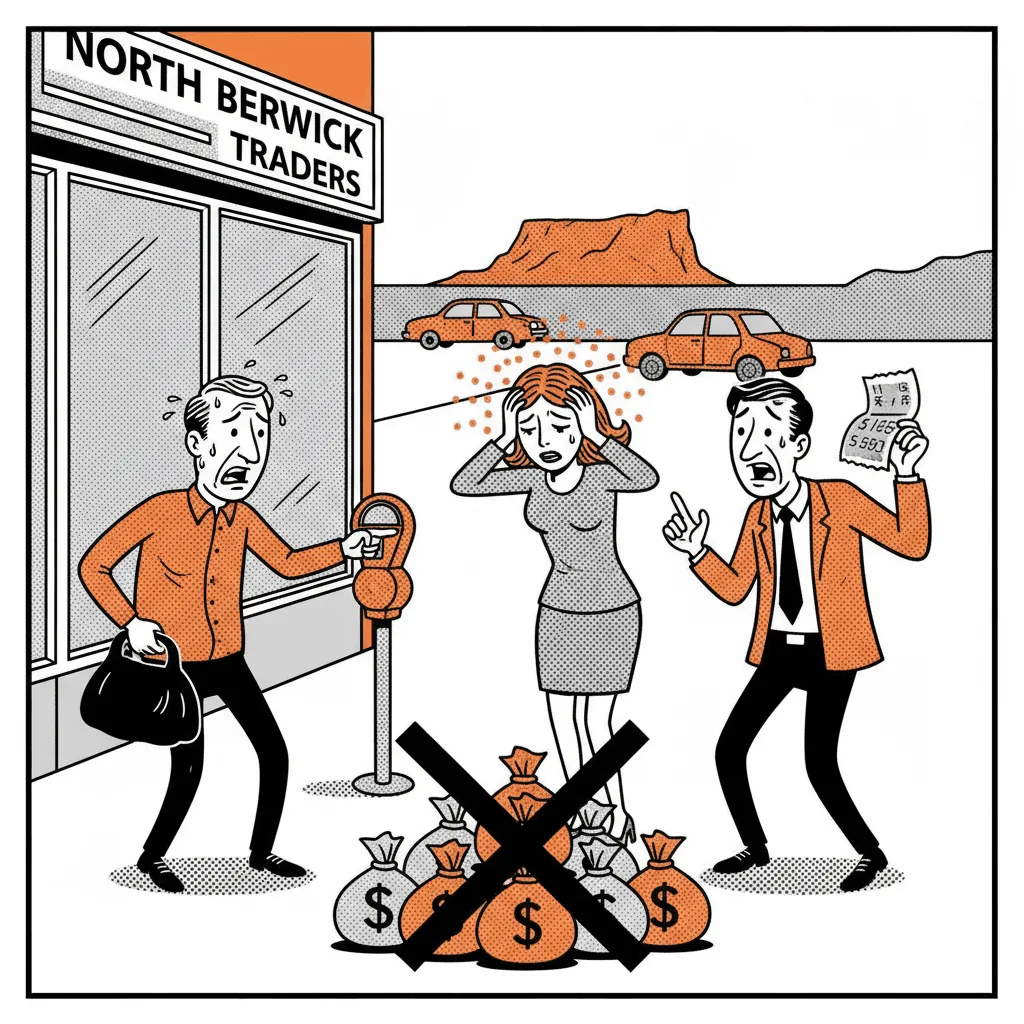
Independent traders in North Berwick say they are losing up to £1,000 a day in revenue since East Lothian Council introduced new parking charges in the town. The losses, reported directly by business owners to the Edinburgh Evening News, are not projections or estimates. They are till receipts compared week on week, and the gap is stark. Footfall has dropped, passing trade has dried up, and the businesses most exposed are precisely the kind of owner-operated shops, cafés, and services that make a coastal high street worth visiting in the first place.
The traders asked the council for a pause on the charges while the economic impact could be properly assessed. The council said no. That decision is now the centre of a dispute that goes well beyond North Berwick, because it raises a question that applies to every Scottish town where councils are looking at parking as a revenue stream: who carries the cost when policy gets the balance wrong, and how quickly does anyone in local government actually find out?
The timing matters. UK retail footfall has been under sustained pressure for several years. According to the British Retail Consortium, Scottish high streets saw footfall declines of around 4 percent year-on-year in 2023, with smaller towns and tourist-dependent locations particularly vulnerable. North Berwick, for all its popularity as a day-trip destination, runs on discretionary spending. Introduce friction at the point of arrival, and customers make a simple calculation: is this worth the hassle and the cost? Some of them are clearly deciding it is not.
This is not an argument against parking charges in principle. Town centres need to manage traffic, and councils face genuine funding pressure. But the Scottish Retail Consortium has consistently argued that charge levels and implementation timing have to be calibrated against local economic conditions, not applied as a blanket policy. A commuter car park in a city centre is a different animal from a coastal high street where the car is often the only realistic way to arrive with children, bags, or a mobility need. Those distinctions matter, and traders say they were not meaningfully consulted before the charges went live.
The Scottish Government's Town Centre Action Plan, updated in 2023, explicitly identifies footfall support and local business viability as priorities for planning and transport policy. It calls on local authorities to assess the cumulative impact of access restrictions on town centre economies before implementing them. Whether East Lothian Council's process met that standard is now a legitimate question, and one the traders appear to be pushing hard. For SME owners elsewhere in Scotland, the lesson is clear: engage with parking and transport consultations before they close, not after the charges appear on the signs.
What happens next in North Berwick will be instructive. If the council holds firm and the losses mount, this becomes a case study in what inadequate impact assessment costs a community. If the traders sustain enough pressure to force a review, it sets a useful precedent for high street businesses across Scotland who are watching this closely. Either way, the data the traders are gathering now, till by till, day by day, is exactly the kind of evidence that shifts policy. Keep collecting it.