

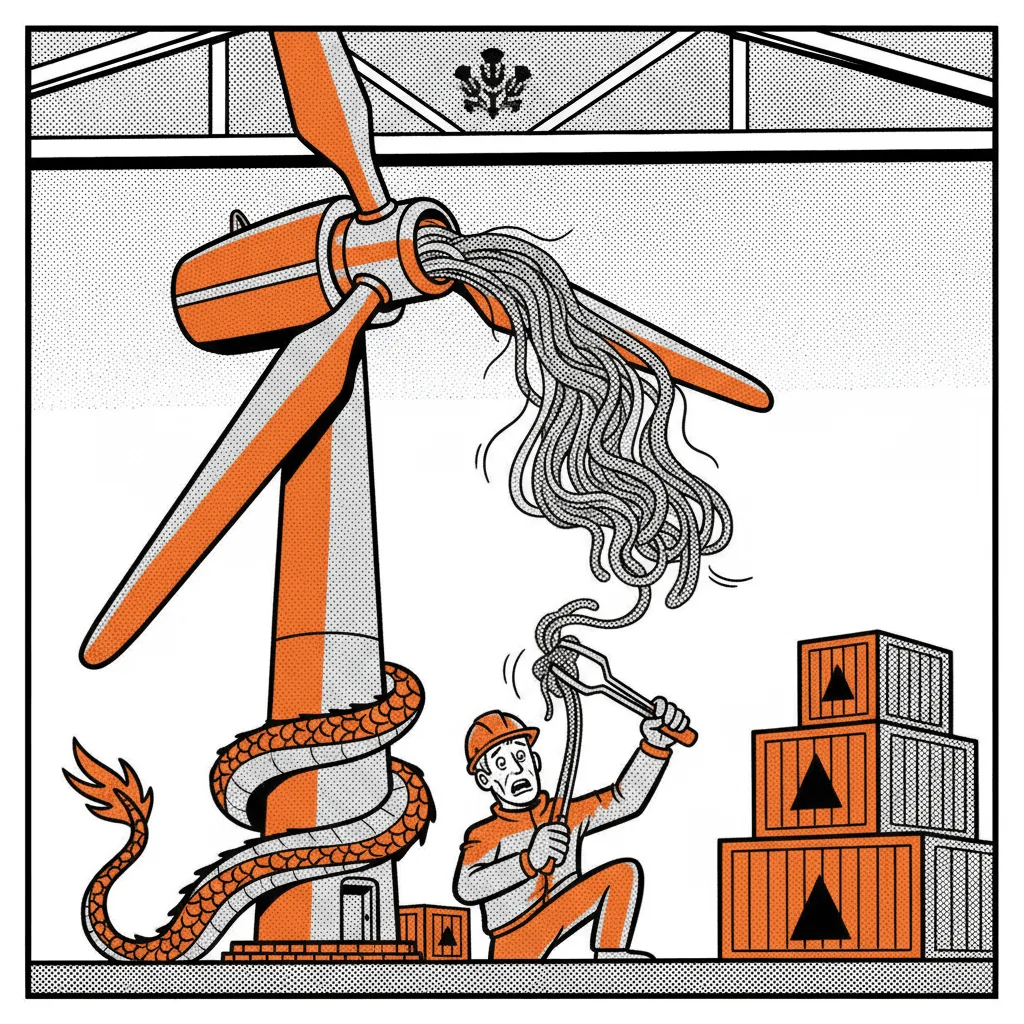
Asbestos has been found in wind turbine components sourced from Chinese manufacturers, according to reporting by the Daily Business Group. The contaminated parts were identified during procurement and inspection processes, though the scale of the issue across the wider UK wind sector remains unclear. What is clear is that the problem exists, it is in active supply chains, and Scotland's renewables sector is exposed.
Scotland hosts more installed wind capacity per head than anywhere else in the UK. According to Scottish Government figures, wind power generated the equivalent of 113% of Scotland's total electricity consumption in 2023, with offshore development accelerating sharply. That scale means a vast network of contractors, sub-suppliers, logistics firms, and specialist tradespeople feeds directly into turbine installation and maintenance. If contaminated components are moving through that pipeline, the risk is not confined to the energy giants at the top of the chain.
Asbestos has been banned in the UK since 1999, and its presence in imported goods is illegal under the Control of Asbestos Regulations 2012, enforced by the Health and Safety Executive. The HSE's guidance is explicit: importers bear legal responsibility for ensuring goods entering the UK comply with domestic regulations, regardless of where they were manufactured. That obligation flows down through the supply chain. A Scottish engineering firm fitting components it reasonably believed were compliant can still face liability if those components later prove otherwise, particularly if adequate due diligence was not documented.
The deeper issue is one of procurement transparency. Research from the Supply Chain Sustainability School, which works extensively with UK construction and energy contractors, consistently identifies third-party verification of materials as a weak point in complex international supply chains. The pressure to reduce turbine costs has pushed procurement toward lower-cost manufacturing bases, primarily in China, where regulatory frameworks differ substantially from UK standards. The UK Wind Energy Association, now merged into RenewableUK, has previously flagged country-of-origin transparency as an area requiring stronger industry standards, though binding requirements remain limited.
For Scottish SMEs working in construction, maintenance, engineering, or logistics around renewables projects, the practical exposure is real. If your firm handles, installs, or works near turbine components, you have a duty under the Control of Asbestos Regulations to ensure your workers are not exposed to asbestos fibres. That duty does not pause because a tier-one contractor told you the parts were fine. It also opens a conversation about contractual indemnity: who carries the liability if a component your firm fitted turns out to be contaminated? If that clause is not explicit in your contract, it probably defaults to you.
Scotland's renewable energy ambitions are sound and the long-term direction is right. But ambition without supply-chain rigour is a liability waiting to mature. The Scottish Government's Just Transition Commission has emphasised that the energy transition must be built on high standards, for workers and for communities. Asbestos in the supply chain is exactly the kind of issue that tests whether that commitment holds when it gets inconvenient. Procurement teams, project managers, and the SMEs who serve them need to be asking harder questions of their suppliers, right now, before the next turbine goes up.