

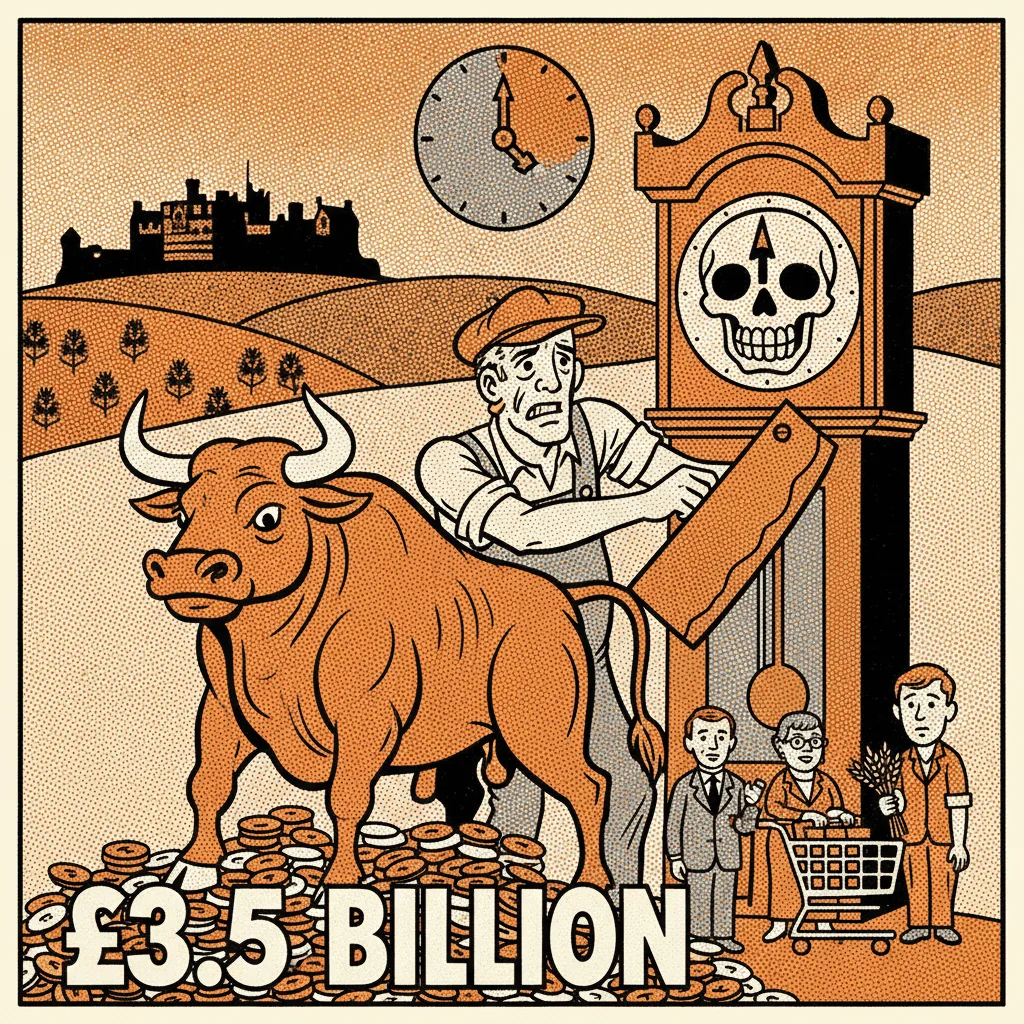
Scotland's red meat sector has hit a record £3.5 billion in economic value, according to new research from Quality Meat Scotland (QMS), the industry body responsible for promoting and developing Scottish beef, lamb, and pork. Consumers are holding firm on home-grown produce, with demand for Scottish-labelled meat remaining resilient despite cost-of-living pressure across the board. On paper, this is a sector firing.
But the farmers producing that £3.5 billion are not celebrating. The QMS research flags a structural tension that the headline figure obscures: input costs, land pressures, generational succession gaps, and policy uncertainty are squeezing margins at the farm gate even as retail value climbs. Scotland's agricultural workforce is ageing, and the economics of livestock farming are not reliably attracting the next generation into the sector. According to the Scottish Government's own agricultural census data, the number of farm holdings in Scotland has been in long-term decline, and the average age of a Scottish farmer sits well above 55.
The trade exposure angle matters for Scottish SMEs too. The UK's post-Brexit agricultural trade arrangements remain in flux, with the Australia and New Zealand free trade agreements now live and introducing lower-tariff competition for exactly the lamb and beef categories where Scottish producers have built premium positioning. The National Farmers Union Scotland has been vocal about the asymmetry: Scottish farmers must meet some of the world's most stringent welfare and environmental standards, while imported product faces no equivalent requirement at the border. That is not a level playing field, and the QMS research implicitly acknowledges it.
For businesses in the Scottish food supply chain, the £3.5 billion figure represents real commercial infrastructure. Abattoirs, hauliers, butchers, food manufacturers, hospitality buyers, and rural retailers all sit downstream of farm-gate decisions. If primary production contracts because the economics stop working for farmers, the ripple effect moves quickly through that chain. The Scottish food and drink sector as a whole contributes around £15 billion to the economy annually, according to Scotland Food and Drink, and red meat is one of its load-bearing pillars.
The opportunity sits in the premium positioning Scotland has already earned. Scottish beef and lamb carry genuine provenance value that can command price premiums in both domestic and export markets, and QMS has done solid work building that case internationally. The ask from the industry now is consistent: policy support from Holyrood on future agricultural payments, a serious conversation with Westminster about import standards, and investment in rural infrastructure that makes farming viable as a career rather than just a heritage act. Scotland has the land, the climate, the breed quality, and the brand. What it needs is the policy environment to match.