

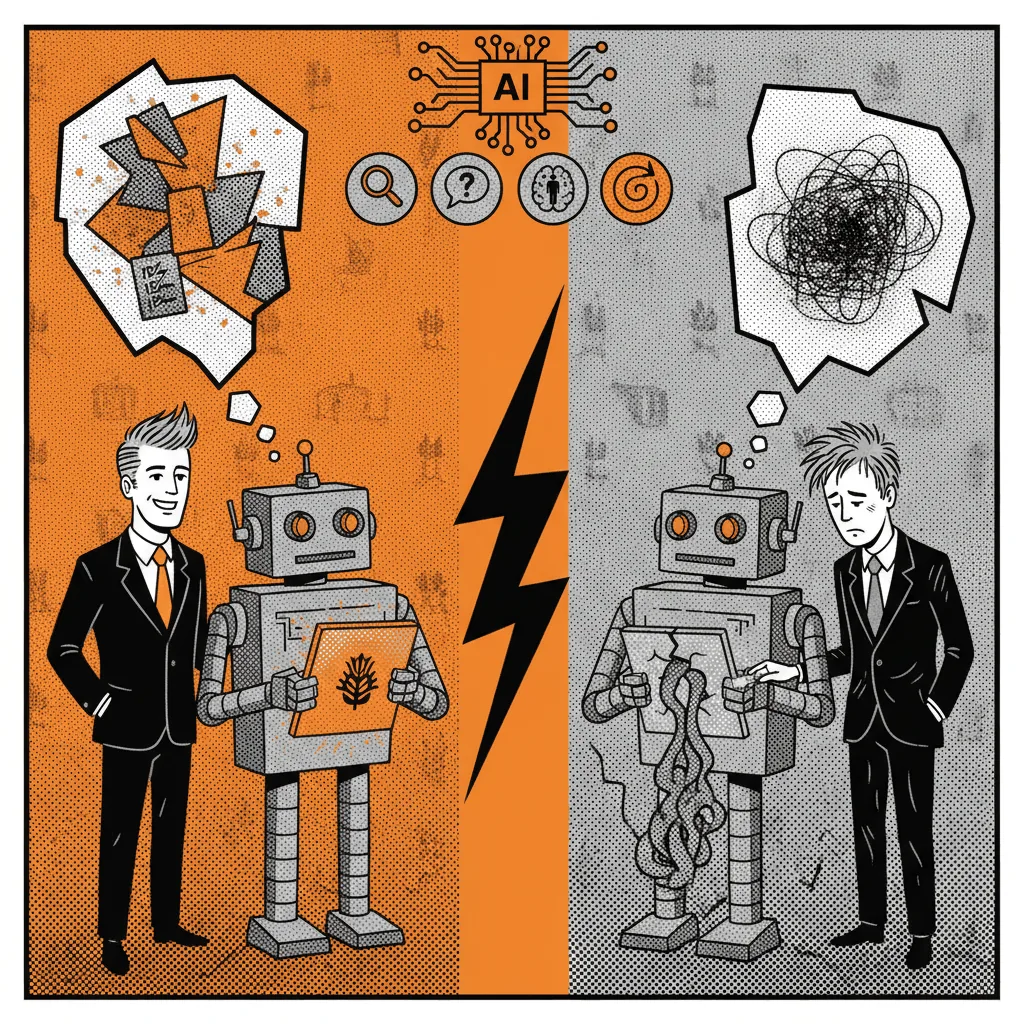
Around 58% of UK small business owners have now used AI tools for at least one business task, according to the Federation of Small Businesses. But adoption figures don't tell the full story. Plenty of those owners tried it once, got something generic and useless, and quietly went back to doing things manually. The problem isn't the AI. It's the approach.
The core mistake most first-timers make is treating AI like a search engine: vague question in, miracle answer expected out. Ask ChatGPT to "write me some marketing copy" and you'll get marketing copy that could belong to any business on earth, in any industry, in any city. It means nothing because it was told nothing. The entrepreneurs who extract genuine value start differently, they give the AI a job with actual detail. Who is the customer? What's the offer? What tone should it land in? What should it never say? The more precise the brief, the more useful the output.
Research from the Chartered Institute of Marketing found that personalisation is the single biggest driver of marketing effectiveness for small businesses, and that applies equally to your AI outputs. Context is everything. A one-person accountancy firm in Leith and a 12-person engineering consultancy in Aberdeen might both be using Claude or Gemini, but the one who loads in their specific client profile, their firm's tone of voice, and the exact problem they're solving will get something worth using. The other will get a polished-sounding paragraph that says precisely nothing.
Iteration is the second separator. The founders who get real value don't accept the first output and move on, they push back. "Make it shorter." "Cut the jargon." "Now write it as if you're talking to a sceptical GP who's heard every pitch before." This back-and-forth is how you arrive at something that actually works. AI tools are designed for dialogue, not one-shot requests. According to Stanford's Human-Centred AI Institute, users who engage in multi-turn refinement sessions consistently rate AI output quality significantly higher than those who treat the tool as a vending machine.
The third factor is the one nobody in a vendor's marketing brochure will mention: human judgment still closes the deal. AI can produce a cracking first draft of a proposal, a well-structured business plan, a decent social media calendar. But the person running the business still needs to read it critically, cut what doesn't fit, add the specific details that only they know, and make the final call. The most effective AI users aren't the ones who hand everything over, they're the ones who use it to move faster on the 80% and then spend their actual expertise on the 20% that matters. That's the model. That's how one person moves like a team of five.
For Scottish SMEs, this matters right now because the gap between AI-effective and AI-confused businesses is starting to show up in competitiveness. Business Gateway Scotland runs free digital skills workshops across the country, including AI tool introductions, and if you haven't looked at what's available in your area this quarter, that's the first practical step worth taking today. The tools aren't expensive. In many cases they're free. The edge is entirely in how you use them.