

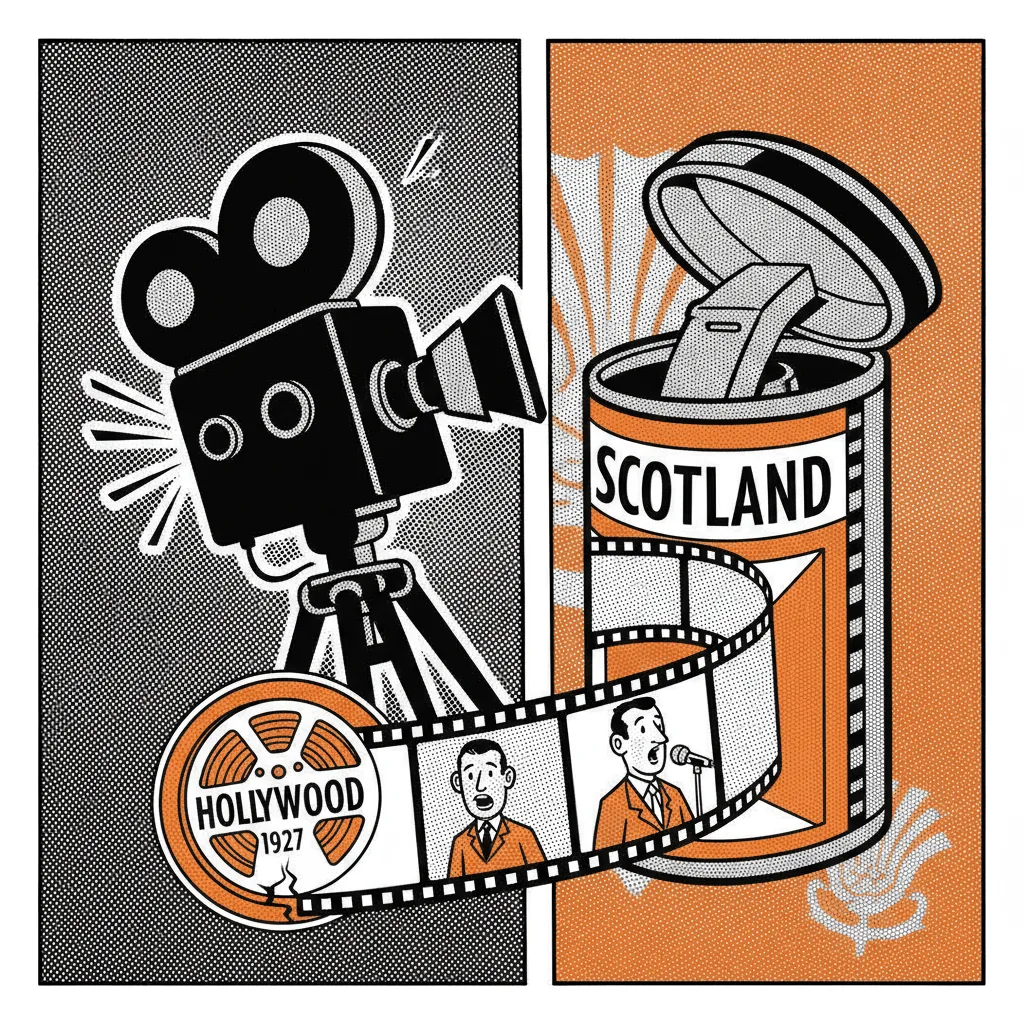
In 1927, Al Jolson opened his mouth on screen and Hollywood declared itself the inventor of sound cinema. The Jazz Singer became a cultural monument, a fact taught in film schools, repeated in documentaries, and accepted without much argument ever since. New evidence, however, points to Scotland getting there first.
Researchers and film historians are now examining the case for The Clue of the New Pin, a British production with significant Scottish involvement, as the earliest feature-length talking picture on record. According to reporting by BBC Scotland, fresh archival work suggests the film predates The Jazz Singer's celebrated premiere, quietly making history in the kind of way Scotland has a habit of doing: without the fanfare, without the marketing budget, and without anyone in Hollywood paying the slightest attention.
Scotland's contribution to global culture, science, and technology is not a new story. The country that gave the world the telephone, the television, and penicillin has a well-documented habit of inventing things and letting others take the credit. The University of Edinburgh's research into Scottish innovation history has repeatedly highlighted this pattern, and the British Film Institute holds extensive records of early British sound experiments that have never received the mainstream recognition of their American counterparts.
What makes this particular claim credible rather than merely flattering is the specificity of the archival evidence being cited. Film historians are not working from rumour. They are working from production records, exhibition dates, and technical documentation of early sound synchronisation technology used in British studios during the mid-1920s. The methodology matters. This is not nationalistic revisionism; it is the kind of careful, source-driven historical correction that occasionally rewrites what we thought we knew.
For Edinburgh and Scotland more broadly, the story lands at a useful moment. Creative industries are a serious economic sector here. Screen Scotland, the joint agency supporting film and television production north of the border, has been building the case for Scotland as a world-class production destination, and stories like this one provide genuine cultural ballast. Scotland was not a footnote in cinema history. It may have been the opening chapter.