

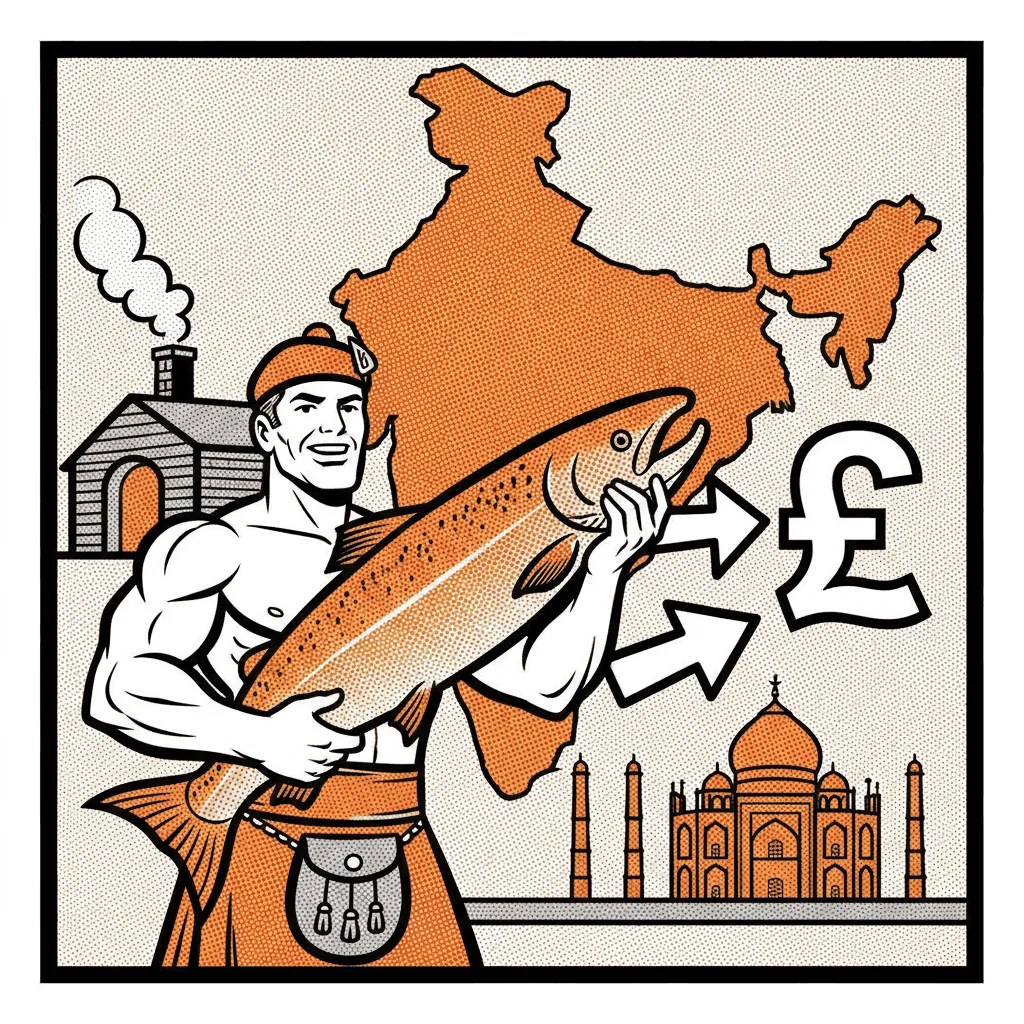
Scotland's salmon producers are formally targeting India as an export market, with the opportunity valued at £130m. That number reflects a rapidly expanding Indian middle class with rising disposable income, a growing appetite for premium imported proteins, and a government-to-government trade relationship that, post-Brexit, Scotland is actively trying to shape through its own international food diplomacy.
The push is being coordinated through Scotland Food and Drink, the industry body that has been driving Scottish export growth across Asia and the Gulf for several years. According to Scotland Food and Drink's most recent export report, the Scottish food and drink sector generated £8.1bn in exports in 2023, with seafood consistently among the top-performing categories. India represents one of the few large consumer economies where Scottish salmon has not yet achieved significant penetration, which is precisely why producers see headroom rather than competition.
India's seafood consumption is changing quickly. A growing urban professional class, particularly in cities like Mumbai, Delhi, Bangalore, and Chennai, is shifting toward premium, internationally sourced proteins. Research from the Marine Products Export Development Authority of India shows the country is one of the world's largest seafood producers, but domestic supply is dominated by lower-cost species. Scottish Atlantic salmon, with its provenance, certification credentials, and premium positioning, sits in an entirely different part of the market, and that gap is the opportunity.
For Scottish SMEs in food and drink, the salmon sector's move into India is worth watching closely, not because every producer sells fish, but because it demonstrates a market-entry model. Coordinated sector promotion, government-backed trade missions, and strong provenance branding are the levers being pulled. The UK-India Free Trade Agreement, currently in negotiation and a significant focus for the UK Department for Business and Trade, could reduce tariffs that currently make premium Scottish exports expensive in Indian retail. If and when those tariffs fall, the window for Scottish food businesses to enter India gets considerably wider.
Scottish Enterprise has been actively supporting international growth programmes for food and drink SMEs, including market-entry funding, export readiness assessments, and in-market support in target countries. Any Scottish food or drink business with a product that carries genuine provenance value, think artisan cheese, premium spirits, smoked foods, or speciality baked goods, should be looking at what the salmon sector is doing and asking whether their own product could follow the same route. India is not a simple market to enter, but it is a serious one, and Scotland is already building the trade infrastructure to make it accessible.