

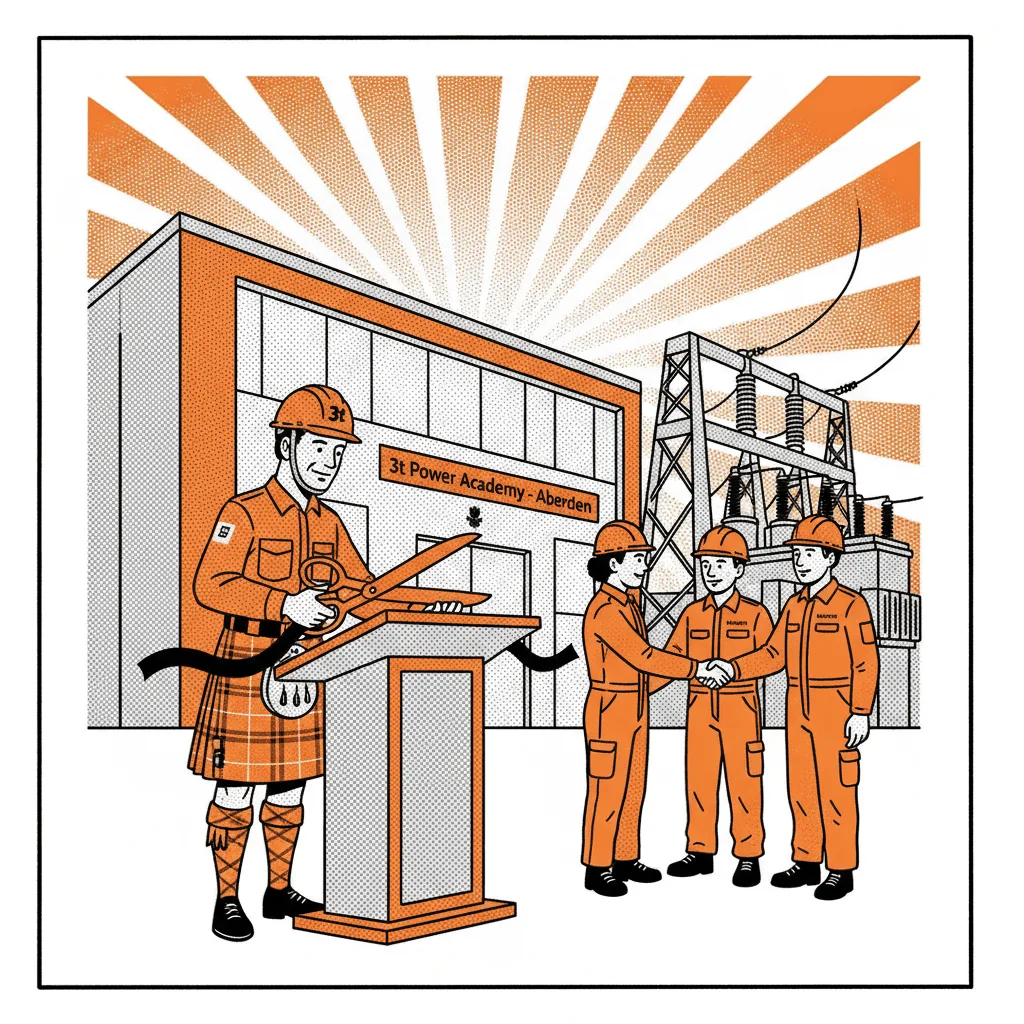
Scotland's energy transition has a workforce problem nobody talks about loudly enough: the grid is being rewired at pace, offshore wind capacity is scaling rapidly, and the specialist engineers needed to make it all work are in short supply. On 21 September 2026, training provider 3t took a direct run at that gap by officially opening the Power Academy in Aberdeen, Scotland's first independent training provider-led centre dedicated entirely to specialist power-sector skills.
The inaugural cohort is five Siemens Energy apprentices working towards substation fitter qualifications. Small number, significant signal. Siemens Energy is one of the largest power infrastructure contractors operating in the North Sea and across the UK grid, and its decision to anchor the first cohort here says something clear about where specialist energy training is heading in Scotland. According to Scottish Business News, the facility was developed in direct partnership with Siemens Energy, meaning the curriculum is built around live industry requirements rather than a generic framework adapted after the fact.
The timing is not accidental. Scotland has committed to delivering 20 gigawatts of offshore wind capacity by 2030, a target that requires a substantial expansion of onshore grid infrastructure, including the substations this apprenticeship programme trains people to build and maintain. Skills Development Scotland has flagged power engineering and electrical infrastructure as critical shortage areas in successive workforce reports, and the Energy Skills Partnership has identified substation competency as one of the hardest roles to fill in the sector.
For Scottish SMEs working anywhere near the energy supply chain, whether in civils, electrical contracting, equipment supply, project management, or specialist services, this matters beyond the headline number of five apprentices. Facilities like this create a regional talent pool. Aberdeen has long been the operational heart of Scotland's energy industry; a Power Academy there means qualified substation fitters emerging from a structured programme with industry-recognised credentials, available to a market wider than Siemens Energy alone. 3t already operates substantial training infrastructure across the oil and gas sector, so the operational credibility is established.
The broader policy context is worth noting. The Scottish Government's Just Transition Commission has consistently argued that workforce development must run in parallel with energy infrastructure investment, not follow it years later. A privately-led, employer-partnered training centre of this kind is exactly the model that body has advocated for: responsive, industry-funded, and locationally relevant. Whether more cohorts follow, and whether the programme scales to take apprentices from smaller contractors and not just tier-one partners like Siemens Energy, will determine how much genuine impact this facility delivers across the Scottish energy SME ecosystem.