

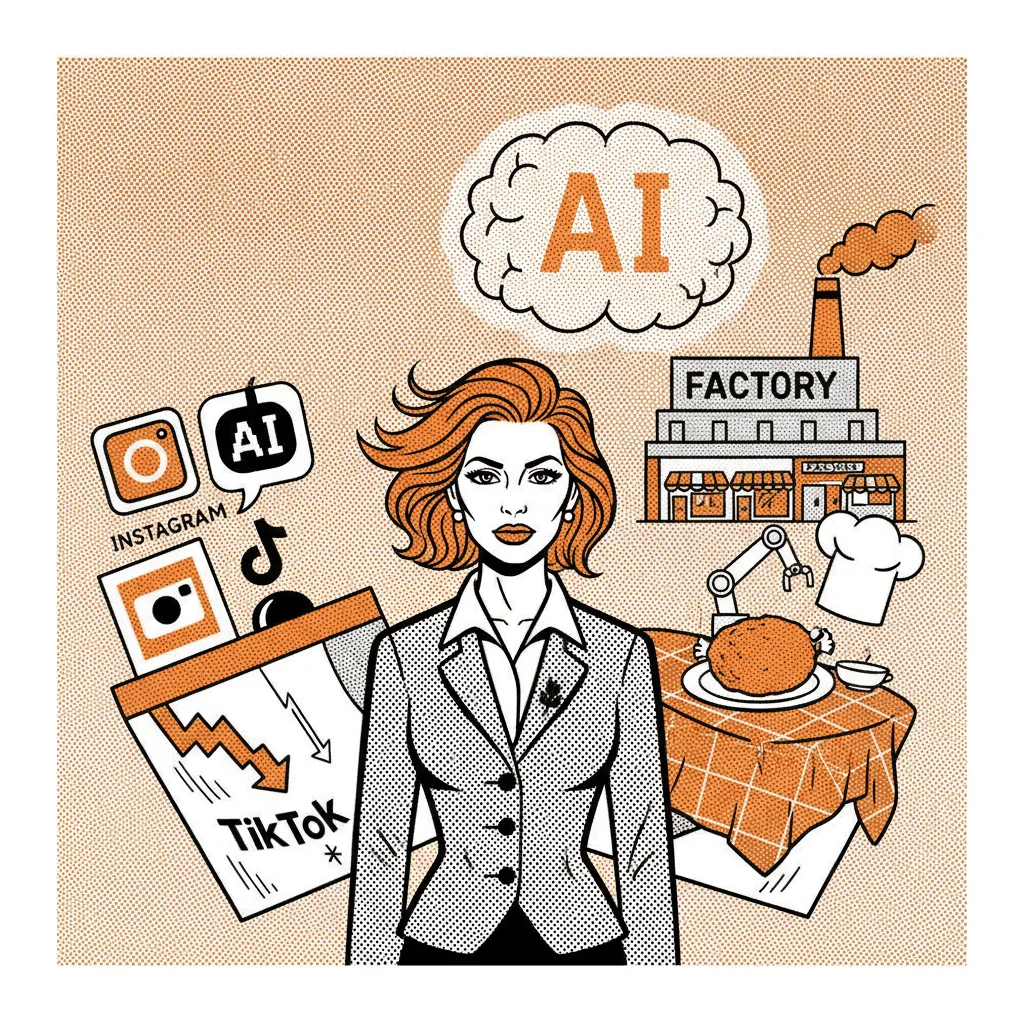
Hana Mohan led AI development at Instagram during the period the platform used machine learning to claw back ground from TikTok's recommendation engine. That is not a small thing. She was operating at a scale most technologists never touch, building systems that shaped what hundreds of millions of people saw every day. Then she walked away from it to fix staff scheduling and food waste for independent restaurants.
That choice is worth sitting with for a moment. Because what it says is this: the frontier of AI is no longer in the server rooms of Silicon Valley giants. It's in the back office of a café in Leith, a GP practice in Dundee, a primary school in Aberdeen. The tools are there. The gap is in application. Mohan's move is the clearest sign yet that serious AI talent has clocked this and is now building accordingly.
Her company applies the same recommendation and prediction logic she used at Instagram, understanding patterns, anticipating demand, surfacing the right action at the right moment, to the operational chaos that kills small hospitality businesses. According to research from the British Beer and Pub Association, labour and food costs together typically consume between 60 and 70 per cent of a restaurant's revenue. That margin isn't going to survive manual guesswork much longer. AI that learns your Tuesday lunch rush and adjusts your prep accordingly isn't a luxury; it's the difference between viable and not.
This matters beyond restaurants. The Scottish Government's AI Strategy, published alongside the National Strategy for Economic Transformation, explicitly identifies AI adoption in SMEs as a productivity priority for Scotland. Business Gateway and Scottish Enterprise have both expanded their digital adoption support in the past 18 months. The infrastructure to help Scottish small businesses get on board exists. What's been missing is the proof that AI built for giants can actually be resized for a team of six. Mohan is providing that proof in real time.
The University of Strathclyde's Advanced Forming Research Centre and similar Scottish institutions have been tracking AI adoption rates in Scottish SMEs for several years. The consistent finding is that the barrier isn't cost or willingness, it's the belief that these tools were made for someone else. That belief is becoming harder to sustain. When the person who built Instagram's AI decides her most interesting problem is a restaurant's Thursday rota, the technology has definitively crossed the line from enterprise to everyday.
For Edinburgh's SME community, the practical question isn't whether to adopt AI. That ship has sailed. The question is which operational headache is costing you the most hours per week and whether there is already a tool, trained on big-tech logic, priced for small business, that solves it. In most cases, there is. The playbook Mohan is running works for hospitality. Variants of it are already working in retail stock management, healthcare appointment optimisation, and school timetabling. The pattern is the same: prediction, automation, freed-up time.