

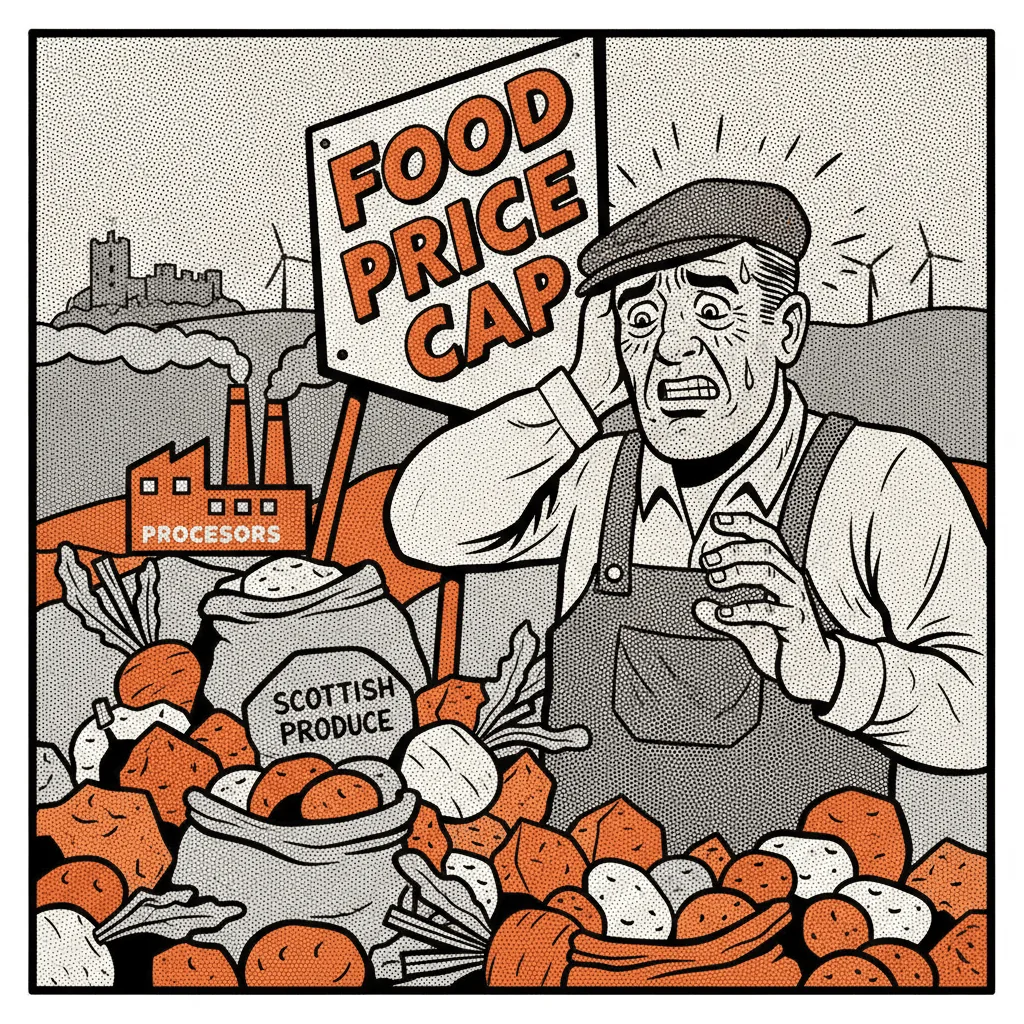
Jamie Wyllie farms in East Lothian. He is not given to drama. But the UK Government's food price cap proposals are, in his words, giving him sleepless nights, because he can see where the costs go when retailers are told to hold their prices. They do not disappear. They travel upstream, arriving at the farm gate in the form of lower margins, tighter contracts, and take-it-or-leave-it terms from the buyers who sit between him and the supermarket shelf.
The concern is structural, not anecdotal. The UK food supply chain already operates on margins that leave producers extraordinarily exposed. According to the Agriculture and Horticulture Development Board, farm-gate prices have consistently failed to keep pace with input cost inflation since 2021, with energy, feed, and fertiliser costs rising sharply while retail prices were held artificially stable by competitive pressure. Any mechanism that further constrains retailer pricing power will, under current contractual norms, transmit that pressure downward. Scottish farmers, who supply a significant share of the UK's beef, lamb, soft fruit, and cereals, sit directly in that transmission line.
NFU Scotland has been vocal on this point throughout the current cost-of-living debate. The organisation has repeatedly warned that policy instruments designed to help consumers can inadvertently devastate producers if they are applied without mandatory fair-dealing protections across the whole supply chain. The Groceries Supply Code of Practice, administered by the Groceries Code Adjudicator, covers only the largest retailers and does not extend protections far enough down the chain to shield the majority of Scottish farming businesses from being used as a cost buffer.
Scotland's food and drink sector is worth more than £15 billion to the Scottish economy, according to Scotland Food and Drink's most recent industry figures. A disproportionate share of that value originates in primary production: the farms, estates, and crofts that supply the raw material. Policy that erodes farm-gate returns does not stay on the farm. It reduces investment, accelerates consolidation, forces smaller operators out, and ultimately narrows the supply base that Scottish food businesses, processors, and exporters depend on. The Scottish Government's Good Food Nation Act set out ambitions for a fair and sustainable food system. A price cap that transfers risk onto producers sits awkwardly against that framework.
For Edinburgh and Scottish SMEs in food service, hospitality, catering supply, or specialist retail, this matters beyond the headlines. A squeezed farming sector means less investment in quality and provenance, more pressure on the mid-tier suppliers you already buy from, and potential disruption to the Scottish sourcing stories that differentiate your offering. The independent deli, the farm-shop supplier, the school caterer trying to source local, all of them depend on a farming sector that can afford to stay in business. That is what is at stake in a policy debate that looks, from Westminster, like a consumer win.