

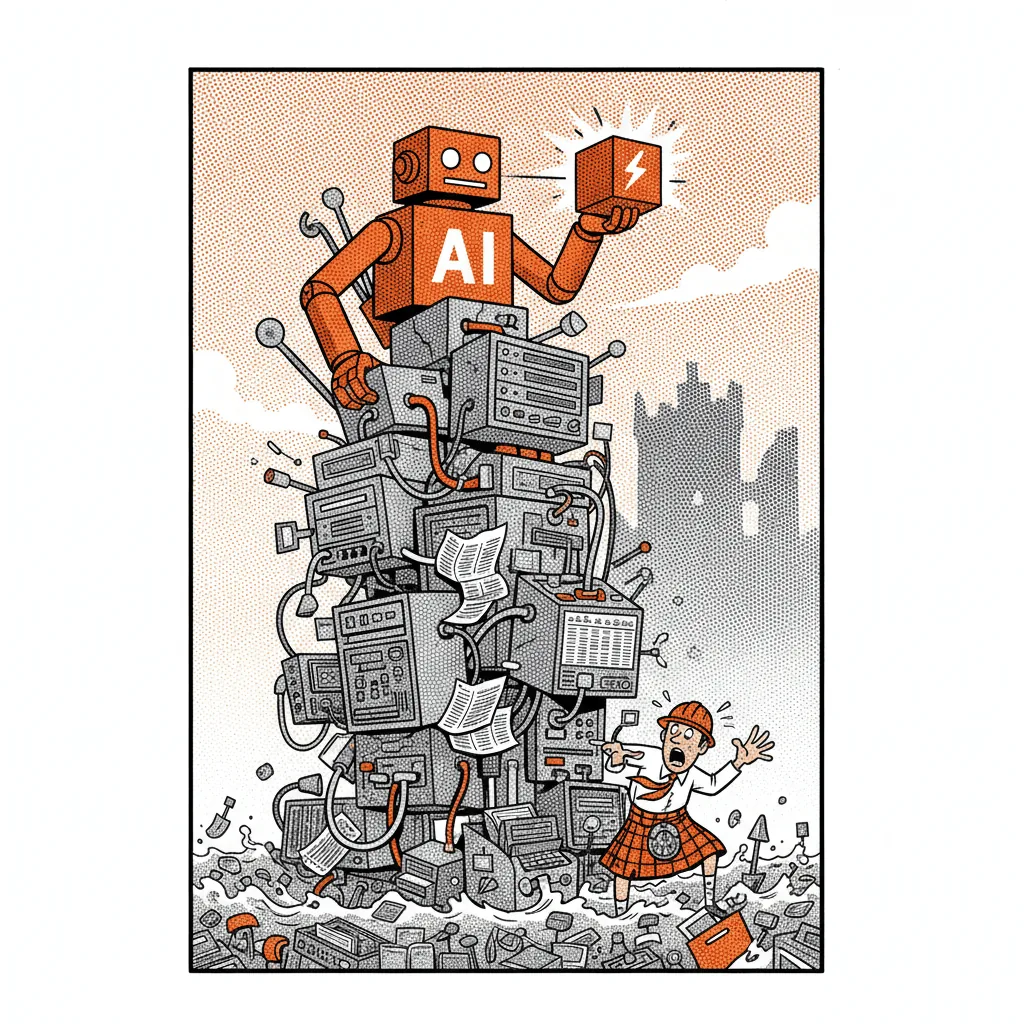
At some point between five employees and fifty, the spreadsheet stops being a tool and starts being a risk. A tab here, a shared drive there, a site-specific workaround that only one person fully understands. MIT Technology Review's recent deep-dive into how global manufacturer Jabil tackled AI integration at scale puts a name to something Scottish SME owners will recognise immediately: the data silo problem. Disconnected systems don't just slow you down. They actively hide the information you need to make good calls.
Jabil operates across hundreds of sites and tens of thousands of employees, so their version of this problem is cinematic in scale. But the mechanics are identical to what a thirty-person Edinburgh logistics firm or a multi-site healthcare practice deals with every week. According to research from McKinsey Global Institute, companies lose between 20 and 30 per cent of revenue annually to inefficiencies driven by poor data visibility and siloed operations. For a small business, that is not an abstract statistic. That is the margin that decides whether you hire someone or hold off.
The MIT Tech Review piece makes the case that AI integration works best not as a dramatic overhaul but as a layer added progressively on top of existing operations. The principle is worth borrowing: you do not need to replace everything at once. You need to identify where your data breaks down, where decisions get made on guesswork, and start connecting those points first. Tools like Microsoft Copilot, Google's Gemini for Workspace, and purpose-built platforms such as Monday.com's AI layer are now designed precisely for this, built to pull fragmented information into a single readable picture without demanding a full IT project to get started.
The Scottish Government's AI Strategy, published alongside Scotland's wider Digital Strategy, explicitly identifies SME adoption of AI as a priority for productivity growth. Business Gateway and Scottish Enterprise both run funded programmes helping businesses audit their digital operations and identify where automation and AI can reduce manual effort. If you have not had that conversation with your local Business Gateway adviser, it is worth scheduling one. The support exists, and it is specifically designed for businesses that do not have an in-house IT team.
The deeper point from the MIT Tech Review piece is cultural as much as technical. Jabil found that getting staff to trust AI-generated insights required transparency about where the data came from and how decisions were being made. That is true at any scale. If your team does not understand why the AI is surfacing a particular alert or recommendation, they will ignore it and go back to the spreadsheet. Adoption lives or dies on that trust. Build the habit before you build the stack, and involve the people closest to the problem in choosing the tools.