

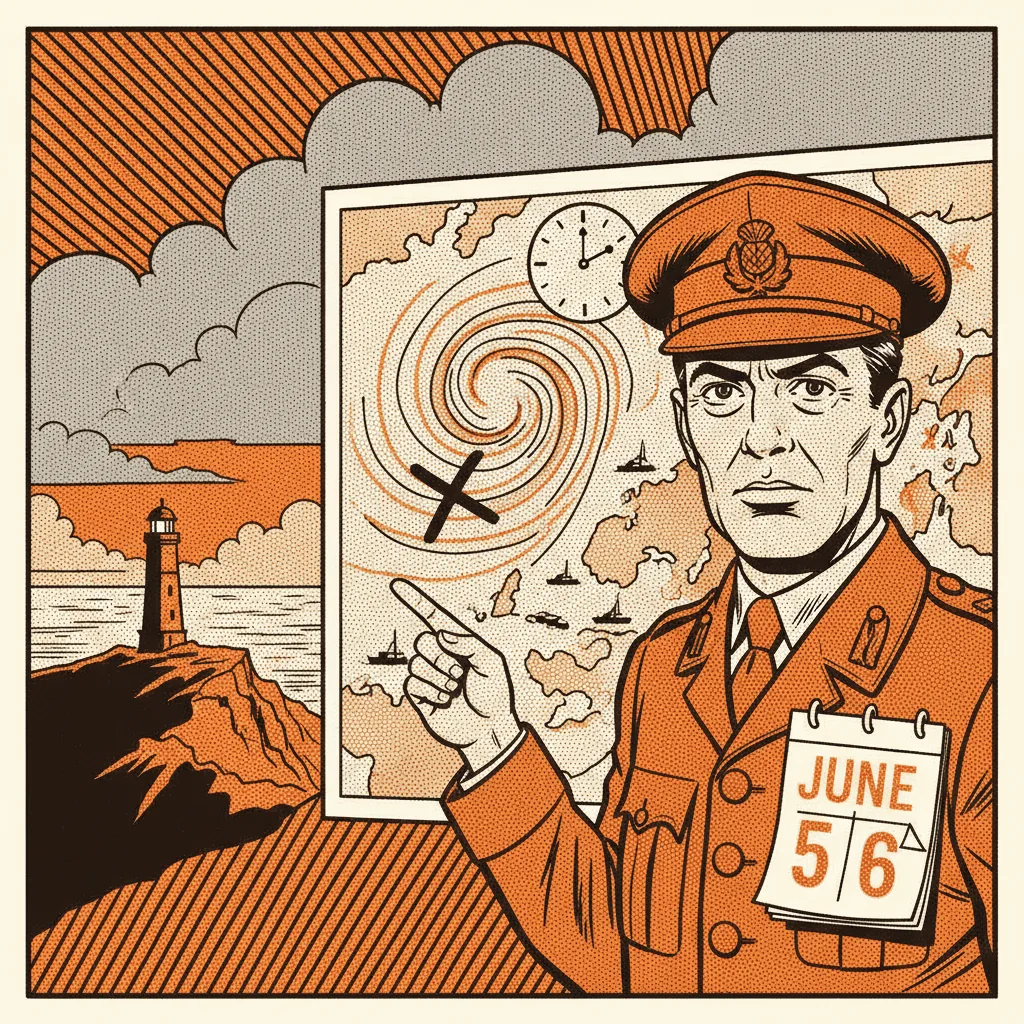
On 4 June 1944, with 150,000 troops staged and ready, General Dwight Eisenhower asked his chief meteorologist whether the invasion of occupied France could go ahead. Captain James Martin Stagg, born in Dalkeith, Midlothian, in 1900, told the Supreme Allied Commander to wait. Eisenhower listened. The rest, quite literally, is history.
Stagg had spotted a narrow weather window opening on 6 June, a brief clearing between Atlantic storm systems that his German counterparts, working with less data and a different forecasting model, missed entirely. Had the invasion launched on 5 June as originally planned, the Channel conditions would have been catastrophic. Had it been postponed further, the tidal and lunar alignment required for the operation would not have recurred for weeks, with consequences no one wants to imagine. Stagg's read of the data, and his willingness to hold his ground in a room full of generals, changed the date of the Second World War's most decisive operation.
The new film Pressure, directed by Roger Mitchell and starring Colin Firth as Stagg, brings this story to a cinema audience for the first time. It focuses on the extraordinary psychological weight of those hours in the forecasting room at Southwick House, Hampshire, where Stagg and his team argued their case against senior officers desperate to launch. According to the Imperial War Museum, Stagg later described those briefings as the most terrifying experience of his professional life, more frightening, he said, than anything the weather itself could produce.
Stagg is not a household name, and that is a genuine cultural oversight. The Royal Meteorological Society has long recognised his contribution, and his 1971 memoir Forecast for Overlord remains in print and is considered essential reading for anyone interested in the operational history of D-Day. But outside meteorological circles and military history enthusiasts, the Dalkeith-born forecaster who arguably saved tens of thousands of lives has gone largely unrecognised in his home country. A film with Colin Firth attached should change that.
For Edinburgh and the Lothians, Pressure is a reminder of something worth sitting with: that world-altering decisions are sometimes made not by generals or politicians, but by specialists who know their data, trust their analysis, and are willing to say an uncomfortable thing clearly and at the right moment. Stagg did not have rank on his side. He had evidence, nerve, and the discipline not to tell the room what it wanted to hear. That is a quality worth celebrating, in any field.