

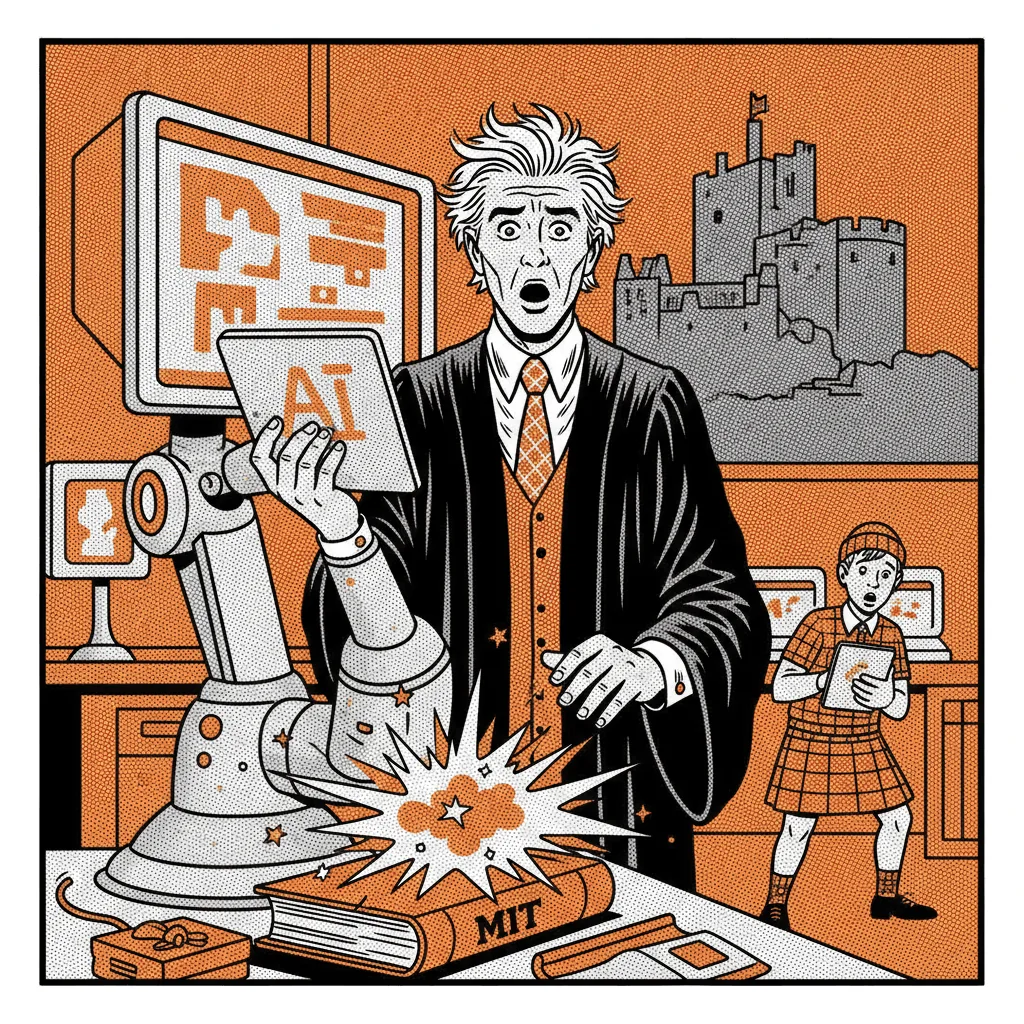
MIT's Committee on Open Learning has published what may be the most honest institutional reckoning with AI in higher education to date. Its conclusion is blunt: AI tools can complete almost any written undergraduate assignment the university sets, across disciplines, to a credible standard. That is not a theoretical concern projected five years out. It is the current state of play, documented by one of the world's most respected research institutions.
The report notes measurable shifts in campus culture in under three years, a timeline that should focus minds in Edinburgh, Glasgow, Aberdeen, and St Andrews. Scotland's universities and colleges are operating in the same AI environment as MIT. The tools available to a student in Morningside are functionally identical to those available in Cambridge, Massachusetts. What MIT is grappling with today, Napier and Heriot-Watt will be navigating tomorrow, if they are not already. According to the Scottish Funding Council's 2023 digital strategy review, Scottish institutions have made meaningful progress on digital infrastructure, but policy on AI-generated work remains inconsistent across the sector.
The EU context adds another layer. Under the EU AI Act, systems that monitor students during remote exams are classified as high-risk applications, requiring strict transparency and human oversight. Emotion recognition technology in educational settings has been outright prohibited. The UK is not inside the EU AI Act's jurisdiction, but Scottish universities with European partnerships, Erasmus successor programmes, or students sitting exams under EU-regulated platforms will need to understand where those lines sit. The Information Commissioner's Office has signalled it is watching how UK institutions handle AI and student data, and guidance is expected to tighten.
The more productive read of the MIT report is not that students are cheating at scale, it is that assessment design itself is overdue for reinvention. If AI can pass the test, the test may not be testing the right thing. Researchers at the University of Edinburgh's Centre for AI in Education have been making exactly this argument: that AI's arrival in classrooms is an accelerant for better pedagogy, pushing educators toward assessments that require synthesis, oral defence, practical application, and genuine critical thinking that a language model cannot fake in real time. That is the opportunity sitting inside this story.
For Scottish educators and training providers, including the many SMEs that deliver professional development, apprenticeships, and workplace learning, the signal is clear. Assessment frameworks built on take-home essays and written submissions alone are already outdated. The institutions that move fastest to redesign learning outcomes around demonstration, not documentation, will produce graduates and learners that employers can actually trust. Scotland has a genuine chance to lead that shift, rather than spend the next decade playing catch-up with policies written in response to the last scandal rather than the next opportunity.