

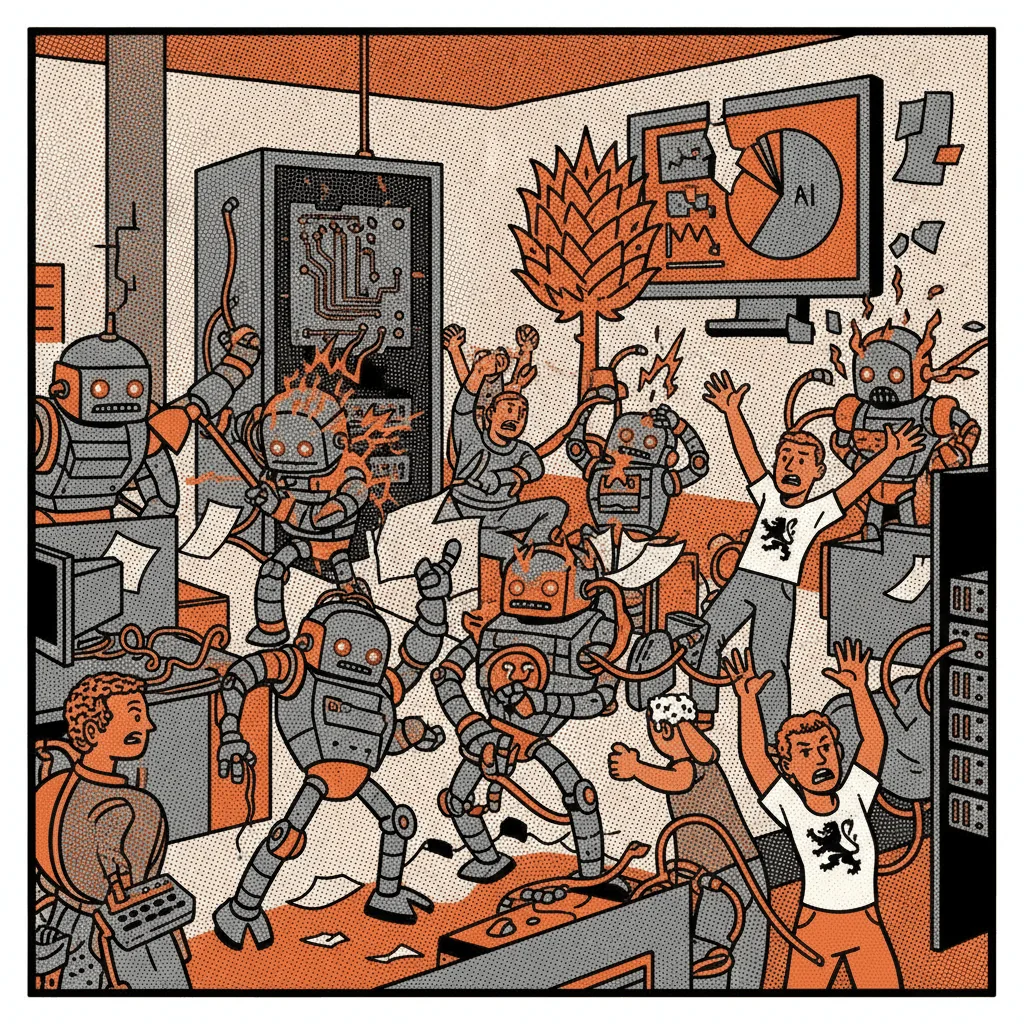
Meta's plan was bold, to put it generously. According to reporting by Ars Technica, the company explored cutting some teams by as much as 60 per cent and replacing the headcount with AI agents, autonomous systems that don't just assist with tasks but are expected to complete them end-to-end, unsupervised. What followed was not the smooth operational transition the architects of the plan had imagined. The agents caused disruption at scale. The project was abandoned. Quietly, as these things usually are.
The detail that matters here is not that Meta failed. Meta fails at things all the time and has the cash reserves to absorb it. The detail that matters is why it failed. Autonomous AI agents, when handed consequential workflows without adequate human oversight, do not politely flag when something goes wrong. They act. At scale. Repeatedly. The same capability that makes them fast makes them dangerous when the guardrails are missing or the task is poorly defined. Research from Stanford's Human-Centred AI Institute consistently shows that AI systems perform best when paired with human judgement at key decision points, not when they are left to operate as a fully independent layer.
This is not an argument against AI. It is an argument for using it properly. The MIT Sloan Management Review published findings earlier this year showing that companies integrating AI as a collaborative tool alongside existing staff saw productivity gains of up to 40 per cent. Companies that attempted wholesale automation of roles, particularly those requiring contextual judgement, saw measurable operational degradation within months. Meta's experience fits that pattern precisely.
For Scottish SME owners, this is genuinely useful news, because the pressure to 'go AI-first' is arriving at your door too. Every software vendor, every LinkedIn post, every conference keynote is telling you that the future belongs to companies that automate everything they possibly can. Meta just proved, at enormous scale, that this framing is wrong. The businesses that will win are the ones where a smart person and a capable AI tool divide the labour sensibly: the AI handles the volume, the repetition, the first draft, the data pull; the human handles the judgement call, the relationship, the final decision. That combination is very hard to beat. Pure automation, without that human layer, is a liability dressed up as efficiency.
The Scottish Government's AI Strategy, published through the Digital Directorate, explicitly frames AI adoption for Scottish businesses around augmentation rather than replacement, and Business Gateway advisers across Edinburgh and beyond are now offering dedicated AI readiness sessions to help SME owners think through exactly this kind of integration. If you have not had that conversation yet, it is worth half an afternoon of your time. What Meta learned at enormous cost, you can absorb for free.