

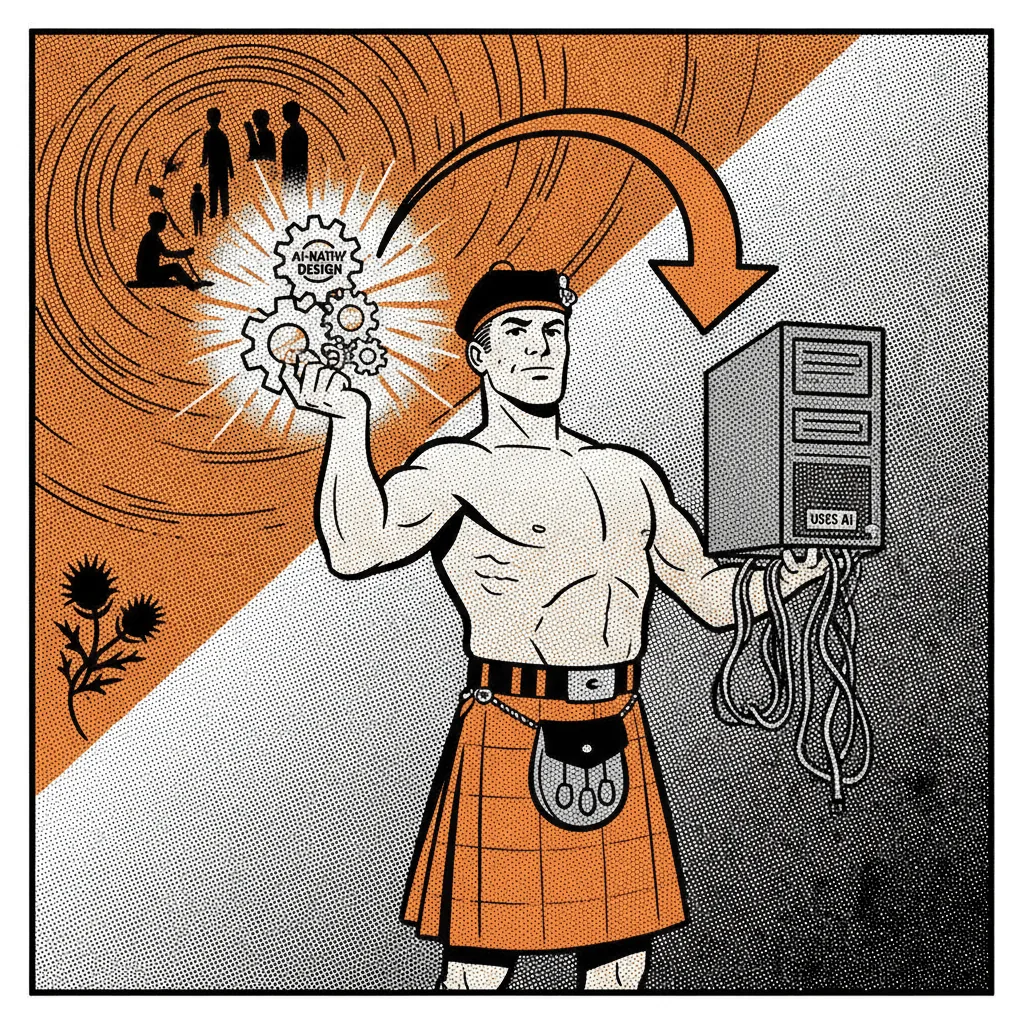
There's a meaningful difference between a business that uses AI and one that's built around it. Right now, the vast majority of Scottish SMEs are in the first camp: they've added Copilot to Microsoft 365, they're running the odd prompt through ChatGPT, maybe they've got an AI scheduling tool for the front desk. Useful, yes. Transformational, no. According to McKinsey's 2024 State of AI report, only 13% of companies deploying AI tools have redesigned core workflows around them. The rest are doing what people always do with new technology: fitting it around the old way of working.
The distinction matters because it determines what you actually get. A solicitor who uses AI to draft a first pass at a contract is faster. A law firm that's rebuilt its intake, research, drafting, and review processes around AI is operating with a fundamentally different cost structure and output capacity. One is an efficiency gain. The other is a competitive moat. The Entrepreneur.com analysis puts it plainly: being AI-native has almost nothing to do with your tech stack and everything to do with how your work is designed, staffed, and measured.
For Edinburgh's solopreneurs and small teams, this is genuinely good news. You don't carry the legacy infrastructure of a large organisation. You don't have a hundred people to retrain or an IT department blocking tool adoption. Research from Deloitte's 2024 SME Technology Report found that smaller firms that redesigned workflows around AI, rather than simply adopting tools, reported productivity gains two to three times higher than those who didn't. The advantage of being small is that you can move. The question is whether you're moving or just accessorising.
What does an AI-native workflow actually look like in practice? It means your first instinct when designing a new process is to ask what AI handles by default, not what humans handle by default. It means your metrics include AI output quality, not just human output volume. A marketing consultancy in this model doesn't hire a junior copywriter for first drafts; it builds a briefing and prompt library that produces first drafts automatically, then staffs for strategy and judgment. A healthcare clinic doesn't use AI to transcribe appointments after the fact; it integrates ambient documentation tools so clinicians are reviewing summaries, not typing them. The Scottish Government's AI Strategy, published in 2023, specifically identifies workflow redesign as the critical adoption barrier for Scottish businesses, noting that tool access is no longer the bottleneck.
The honest question every SME owner should sit with is this: if you stripped out your AI tools tomorrow, how much of your actual working day would change? If the answer is 'not much,' you're using AI. If the answer is 'we'd need to hire two people and add fifteen hours a week,' you're starting to be AI-native. That gap, between convenience and architecture, is where the real competitive ground is being won and lost right now. The businesses redesigning for it today will be very difficult to catch in three years.