

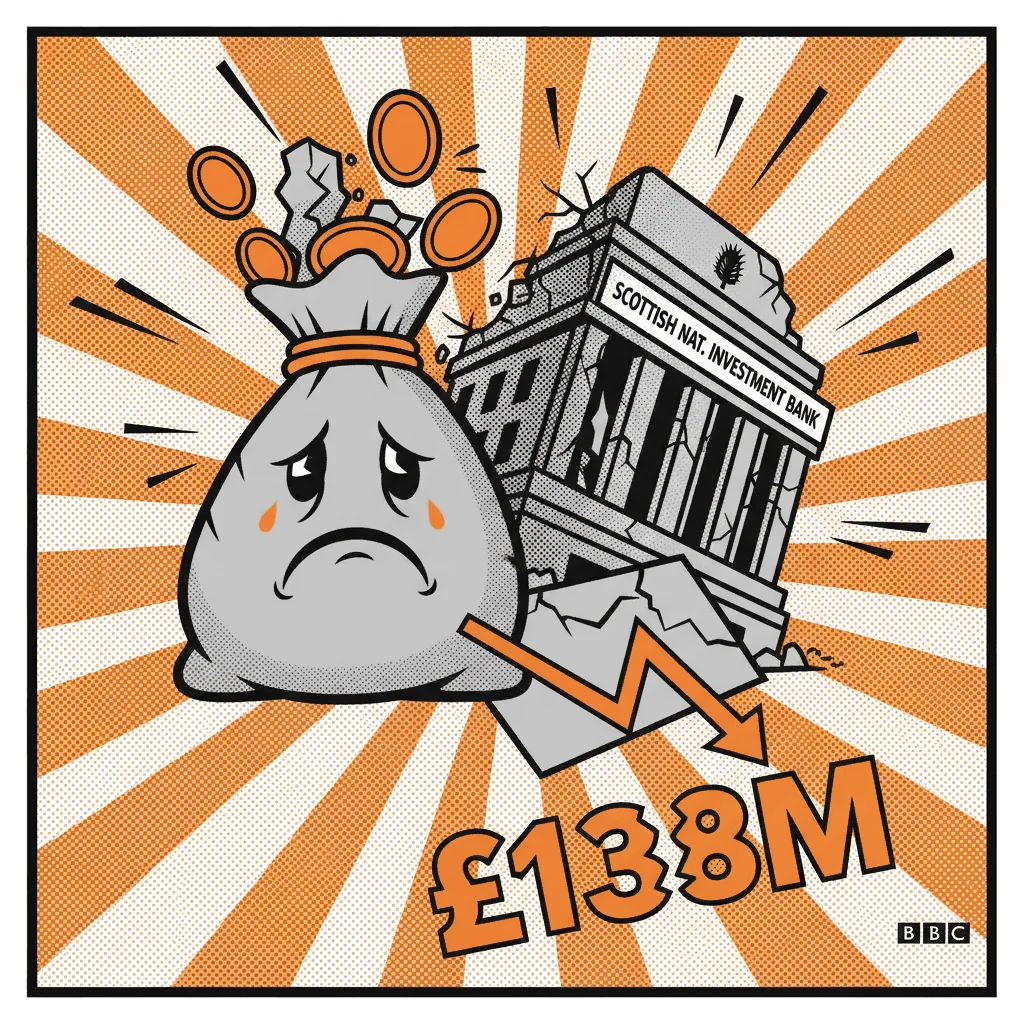
The Scottish National Investment Bank recorded a £138 million net loss in its latest financial results, a figure driven primarily by downward revaluations of its investment portfolio rather than cash haemorrhaging out of the door. The bank was quick to frame this as an accounting reality of long-term patient capital, investments in early-stage businesses and infrastructure that don't pay out in quarterly cycles, but the number is large enough to demand scrutiny, and the bank's leadership has not shied away from using the word 'painful'.
Set up in 2020 with a £2 billion capitalisation mandate from the Scottish Government, the SNIB was designed to do what commercial lenders wouldn't: back Scottish businesses and projects over a 10 to 15 year horizon, accepting short-term losses in pursuit of long-term economic transformation. According to the bank's published mission, its three investment pillars are place, people, and planet, backing regional economic development, reducing inequality, and accelerating the net-zero transition. That framing matters when reading a loss figure. Venture portfolios routinely carry paper losses in years two through five before delivering outsized returns. The question is whether the portfolio quality justifies the patience.
The revaluation losses reflect a broader market reality. Rising interest rates across 2022 and 2023 compressed valuations across unlisted equity and infrastructure assets globally, and Scotland was not immune. Research from the British Private Equity and Venture Capital Association (BVCA) consistently shows that unrealised losses in early-year fund performance are a poor predictor of ultimate returns, it is exits, not interim marks, that tell the real story. The SNIB has not yet reached the stage where significant exits are expected. That is either reassurance or cover, depending on your view of the underlying portfolio quality.
For Scottish SMEs and startups, the more pressing question is whether this result changes the bank's appetite to deploy capital. The Scottish Government has indicated continued commitment to the institution, and the bank retains its £2 billion mandate. Business Gateway Scotland and Scottish Enterprise both signpost SNIB funding as a route for high-growth ventures, particularly in cleantech, life sciences, and digital infrastructure. Those pipelines remain open. What may shift is the internal pressure on the bank to demonstrate near-term credibility, which could mean a preference for lower-risk, more commercially legible deals over genuinely transformational but harder-to-value early bets.
Scotland's startup ecosystem has grown significantly since the SNIB launched. According to Dealroom data, Scottish tech companies raised over £500 million in venture funding in 2023, with Edinburgh and Glasgow accounting for the bulk of activity. The SNIB was intended to catalyse and co-invest alongside private capital, not replace it. If the bank recalibrates its risk tolerance in response to political pressure over this loss figure, the gap it was created to fill, long-term, mission-aligned capital for Scottish businesses that don't fit a conventional VC thesis, could quietly reopen. That would be the real loss, and it would not appear on any balance sheet.