

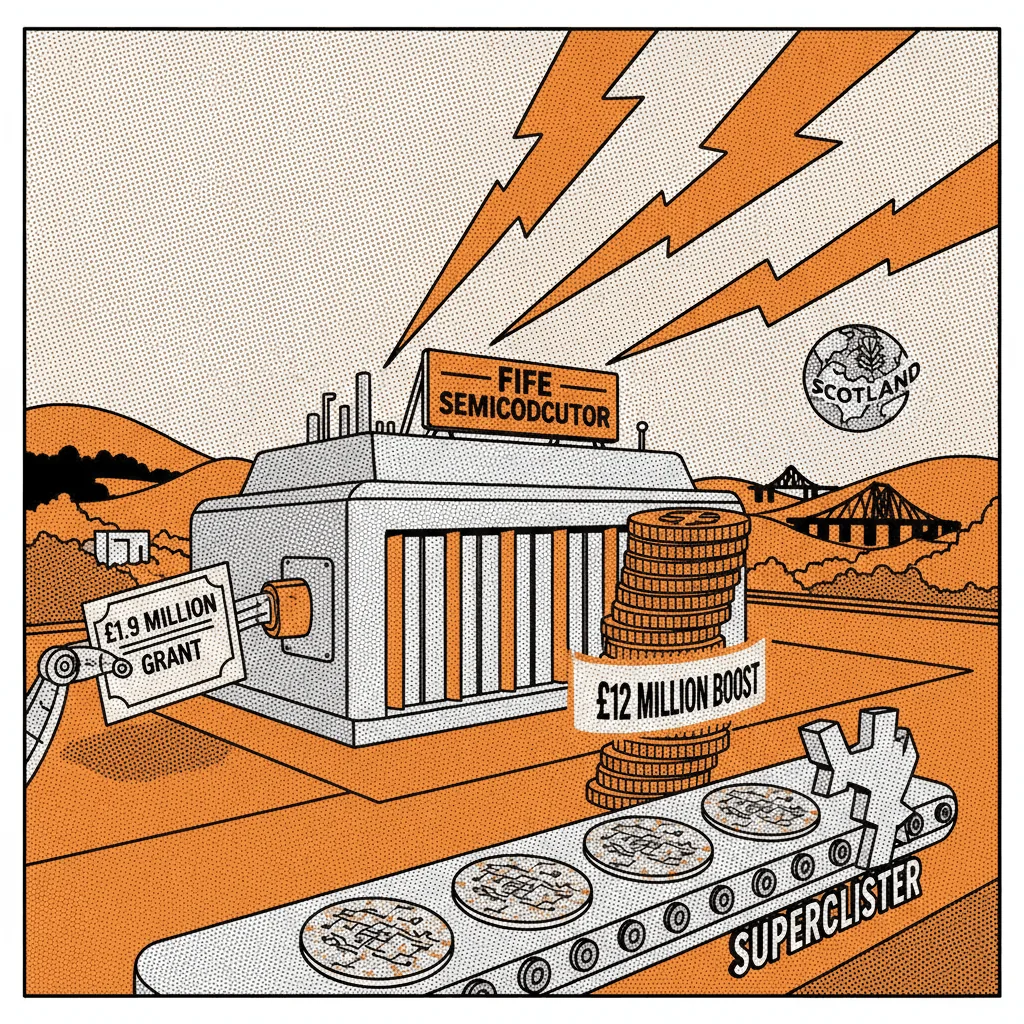
Clas-SiC Wafer Fab, based in Lochgelly, Fife, is scaling up. The company, which manufactures compound semiconductor wafers used in high-power electronics, electric vehicles, and renewable energy systems, has secured a £1.9 million Capital Grant from Scottish Enterprise as part of a broader £12 million investment in its facilities and operations.
The grant makes Clas-SiC one of the first recipients of Scottish Enterprise's Capital Grant programme, a relatively new funding instrument designed specifically to support capital-intensive industrial growth rather than just R&D or early-stage startups. That distinction matters. Scotland has historically been stronger at spinning out university research than converting it into manufacturing at scale. This is a deliberate intervention to close that gap.
Compound semiconductors are not niche technology. According to the Compound Semiconductor Applications Catapult, the global market for compound semiconductor devices is projected to exceed £50 billion by 2030, driven by EV power electronics, 5G infrastructure, and defence systems. Scotland, with its established electronics heritage and strong university research base, is well placed to claim a slice of that. Clas-SiC is one of a small number of dedicated compound semiconductor wafer fabs in the UK, which makes its presence in Fife genuinely strategic.
The investment will expand the firm's manufacturing capacity and create new roles, including apprenticeships, making it a real pipeline for technical talent in a region that has seen its share of industrial decline. Scottish Enterprise's decision to anchor this kind of deep-tech manufacturing in Fife rather than defaulting to a central belt city is worth noting. Lochgelly is not a traditional tech hub, and that is precisely the point. Scotland's Critical Technologies supercluster is being built across multiple geographies, not concentrated in one postcode.
Scotland's broader semiconductor ambitions align with UK Government interest in domestic chip supply following the supply chain shocks of 2020 to 2022, when global semiconductor shortages cost the automotive and electronics industries billions. The UK Semiconductor Strategy, published in 2023, identified compound semiconductors as a priority area. Innovate UK and Scottish Enterprise have both moved to match that ambition with real capital. Clas-SiC's grant is evidence that the strategy is translating into factory floors and apprentice wages, not just policy documents.
For the Scottish tech and manufacturing supply chain, this is a significant data point. A funded, expanding compound semiconductor fab in Fife creates downstream opportunity: materials suppliers, precision engineering firms, logistics, calibration services, and specialist software. The supercluster model is explicitly designed to generate that kind of knock-on effect, connecting anchor companies like Clas-SiC with the smaller businesses orbiting them. According to Scottish Enterprise, the Critical Technologies supercluster spans semiconductors, space, and advanced manufacturing, with the goal of making Scotland a globally recognised cluster by the end of the decade.