

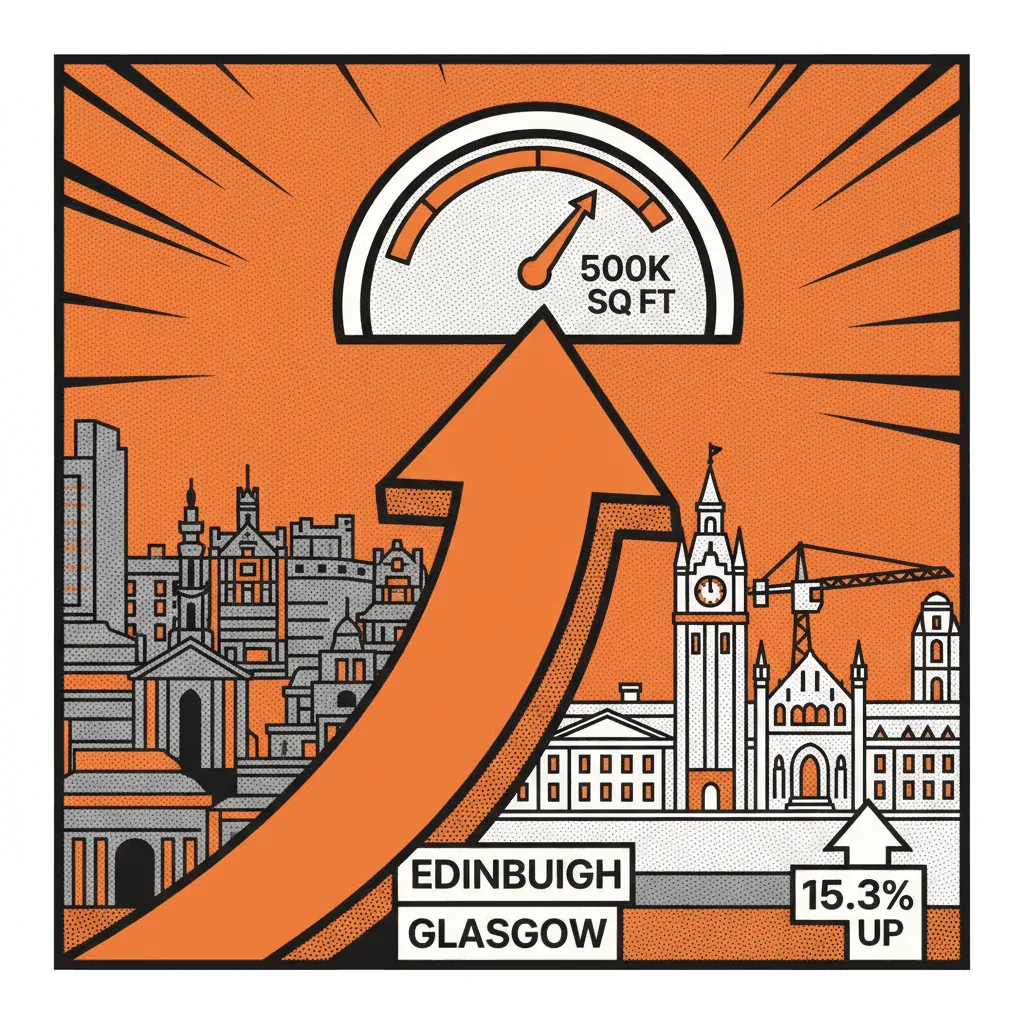
The numbers are hard to ignore. According to Savills, Scotland's two major office markets transacted just under half a million square feet of space between January and June 2026, the strongest first-half performance in recent memory. Glasgow accounted for 300,280 sq ft of that total, roughly 60% of all deals, a figure described by agents as a significant jump on previous years. Edinburgh made up the remainder, and both cities are showing the kind of consistent demand that reshapes lease negotiations in favour of landlords.
A 15.3% year-on-year increase is not noise. It is a directional signal. When take-up rises at that pace, available grade-A stock gets absorbed faster, incentives shrink, and headline rents harden. The Scottish Property Federation has noted for some time that the pipeline of new prime office space in both cities remains constrained, meaning occupiers chasing quality are competing for a limited and slowly replenishing pool. Supply is not keeping pace with the appetite.
For context, this mirrors a broader pattern across UK regional cities. Research from Colliers published earlier this year showed that regional office markets outside London were outperforming pre-pandemic take-up benchmarks in several locations, driven by the flight to quality, firms consolidating into smaller but better space, and hybrid working models that have stabilised rather than collapsed office demand. Scotland is part of that story, not an outlier from it.
The Glasgow surge is particularly worth watching. The city has been closing the gap on Edinburgh in terms of occupier profile and deal size, attracting professional services, financial technology, and public sector consolidations. Edinburgh, meanwhile, remains the preferred address for financial services and legal firms, with strong demand concentrated in the New Town, Exchange District, and Leith's emerging commercial corridor. Both markets are tight at the top end. If you want best-in-class space today, you are competing, and you are likely paying more than you would have twelve months ago.
For SME owners, the practical read is straightforward: the conditions that existed two or three years ago, when landlords were offering long rent-free periods, generous fit-out contributions, and flexible break clauses to fill empty floors, are fading. The Scottish Government's own economic development data consistently shows that commercial property costs rank among the top three concerns for growing Edinburgh and Glasgow businesses. That concern is about to become more acute. If your lease is up for renewal in the next eighteen months, the conversation you have in the next ninety days will be materially different from the one you would have had in 2023.