

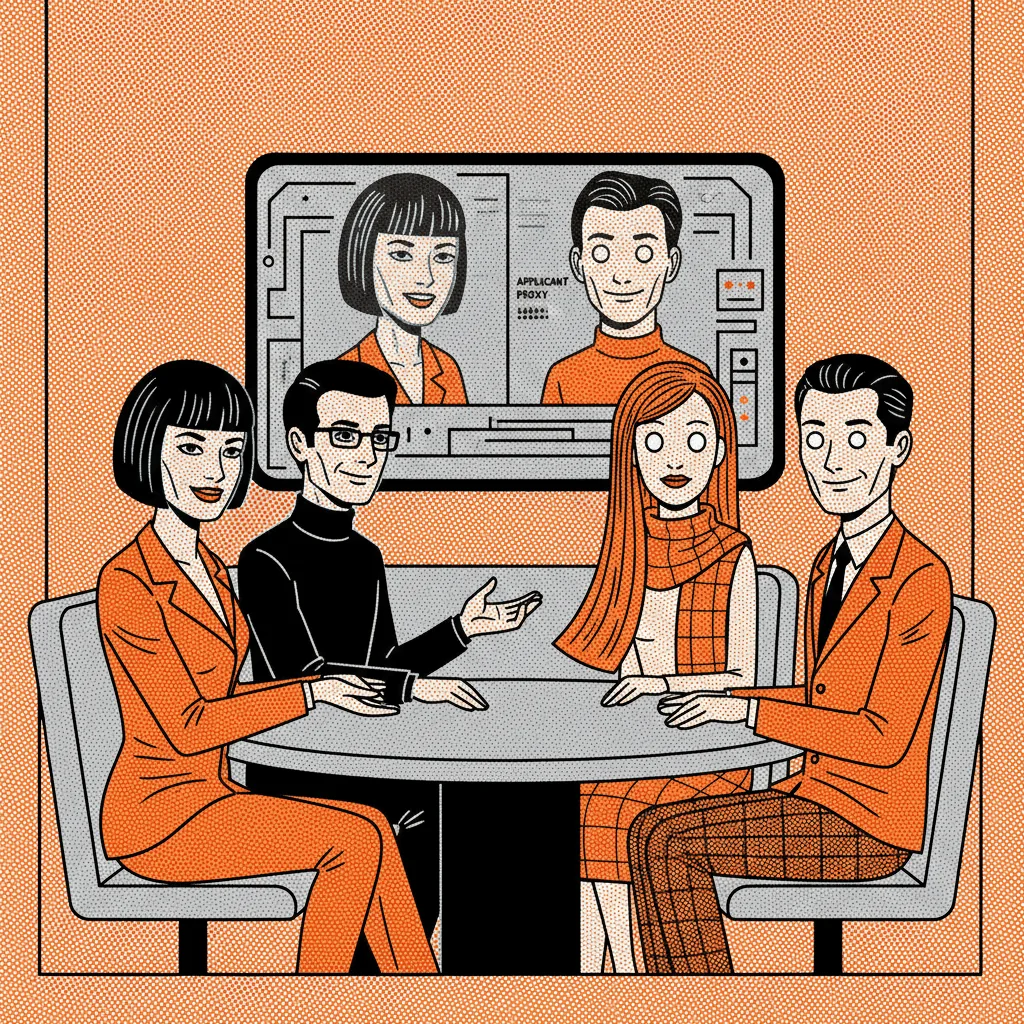
Over the past six months, Sydney-based recruiter Lana Kersanava has been encountering something odd in first-round video interviews: candidates who aren't quite there. Their lips move slightly out of sync. Their eyes don't track quite right. Their answers are fluent, articulate, and entirely generated by AI. She reported the trend to Semafor, and the story has since rippled through HR circles worldwide. Recruiters are using AI avatars to run initial screening interviews. Candidates, having clocked this, are using AI avatars to attend them. The arms race is now official.
The mechanics are straightforward enough. A candidate uses a tool that mirrors their voice and likeness in real time, feeding AI-generated responses through a video call while they sit elsewhere entirely, or do nothing at all. On the recruiter side, automated interview platforms using digital human interviewers have been growing quietly for two or three years, used largely by volume hirers trying to process hundreds of applicants without burning out a team. According to research from the Society for Human Resource Management, more than a quarter of employers were already using AI in some part of their hiring process by 2023. The avatar-on-avatar scenario Kersanava describes is simply the logical end point of that trajectory.
For a large company with a dedicated HR function and a structured multi-stage process, this is inconvenient. For an Edinburgh SME owner hiring their fifth or sixth employee, it is a genuine operational risk. Small businesses typically do fewer interviews, move faster, and rely more heavily on that first conversation to make a call on character and fit. If that conversation is with a well-prompted language model wearing someone else's face, the hire you make is not the person you think you're hiring. The legal and practical fallout lands with you, not with a platform.
There are tells, and they are worth knowing. Video quality that seems slightly too smooth. Micro-delays before responses that follow a consistent pattern. Answers that are impressively structured but oddly generic, hitting every competency box without a single specific anecdote. Eye contact that tracks the camera perfectly but never quite reacts to an unexpected question. The University of Edinburgh's Centre for Technomoral Futures has noted in wider research on synthetic media that the uncanny valley effect remains detectable to trained human attention, even as the technology improves. The practical lesson: ask something genuinely unpredictable. Ask them to describe a specific mistake. Ask a follow-up that requires them to remember what they said thirty seconds ago. Avatars struggle with genuine conversational memory in real time.
The longer-term question is not whether this technology will improve, because it will, dramatically, within eighteen months. The question is whether first-round video interviews will retain any evidential value at all. Some hiring experts, including those writing for the CIPD's People Management publication, are already arguing that the sector needs to move toward task-based assessment and in-person second rounds as the minimum credible bar. For Scottish SMEs, that is actually a competitive advantage: you can still meet people. You have the time and scale to make a phone call, ask to see a portfolio, or invite someone in for an hour. The multinational running ten thousand first rounds through an AI screener cannot do that. Use the size of your business as a feature, not a limitation.