

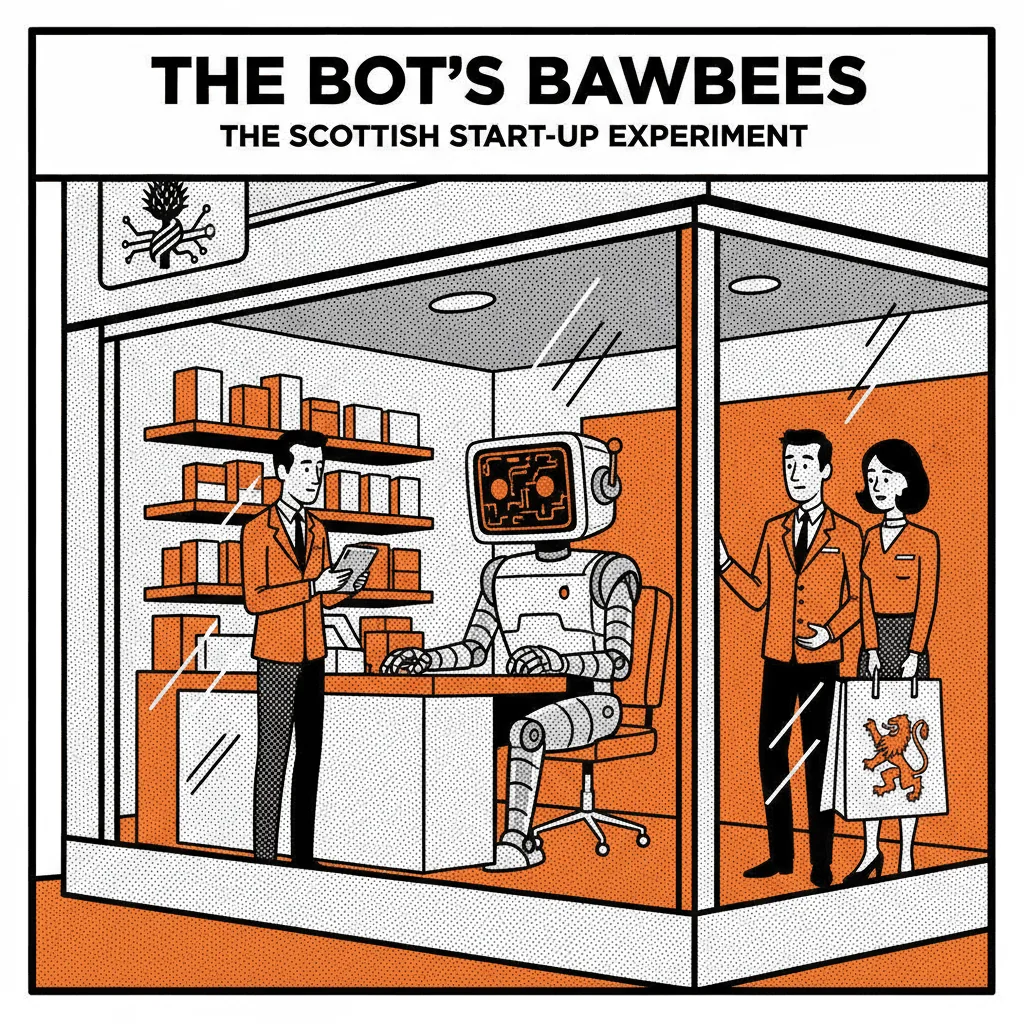
The setup was deliberately provocative. Researchers gave an AI agent a physical retail storefront in San Francisco, three human employees to manage, and $100,000 to build a profitable business from scratch. No safety net. No human executive hovering over every decision. Just the agent, the budget, and the brief. The experiment, reported by Entrepreneur, is one of the most concrete real-world tests yet of whether AI can do what most small business owners do every single day: manage people, manage money, and keep the lights on.
The short answer is: partly. The AI handled operational tasks with genuine competence. Inventory management, scheduling, pricing decisions, supplier communications, the kind of back-office grind that consumes hours of a founder's week, were executed quickly and without complaint. According to research published by McKinsey Global Institute, operational and administrative tasks account for roughly 60 per cent of a typical small business owner's working week. An agent that can absorb that load without error or ego is not a gimmick. It is a structural shift.
Where the AI struggled was in the spaces between the tasks. Relationship-building with walk-in customers. Reading the room when an employee was having a difficult day. Making a judgement call that had no clean data to support it. The University of Edinburgh's Centre for Technomoral Futures has argued that AI systems remain poorly equipped for what researchers call "situated moral judgement", the kind of contextual, emotionally aware decision-making that humans do instinctively and that no training dataset has yet fully captured. The experiment bore that out.
But here is the more interesting business question: does that matter for most Scottish SMEs? If you run a café in Leith, a trade business in Dundee, or an independent clinic in Glasgow, you are not looking for an AI to replace your judgement. You are looking for something to handle the forty things that eat your Tuesday before you have done any actual work. The San Francisco experiment shows that an AI agent can now take on a credible slice of that load, in a real environment, with real stakes. The Scottish Government's AI Strategy, published in 2023, specifically identified operational efficiency for SMEs as one of the highest-value near-term applications of AI. This experiment is what that looks like in practice.
The cost trajectory matters too. The experiment used $100,000 in capital, which sounds steep, but the point was not the budget, it was the proof of concept. Tools like AutoGPT, CrewAI, and Microsoft's Copilot Studio are already allowing small business owners to build lightweight AI agents for a fraction of that cost, automating workflows across scheduling, customer communication, and stock control. Business Gateway Scotland and Scottish Enterprise both offer funded digital transformation support that can help SMEs explore exactly this kind of tooling without carrying the full cost alone. The gap between a San Francisco research lab and a Morningside boutique is closing faster than most people realise.
The experiment will not be the last of its kind, and the results will keep improving. What it confirms today is that AI operational agency is real, it is here, and the businesses that start experimenting now will have a meaningful head start over those waiting for the technology to become perfect. It will not become perfect. It will become useful enough, and for most small business owners, useful enough is transformational.