

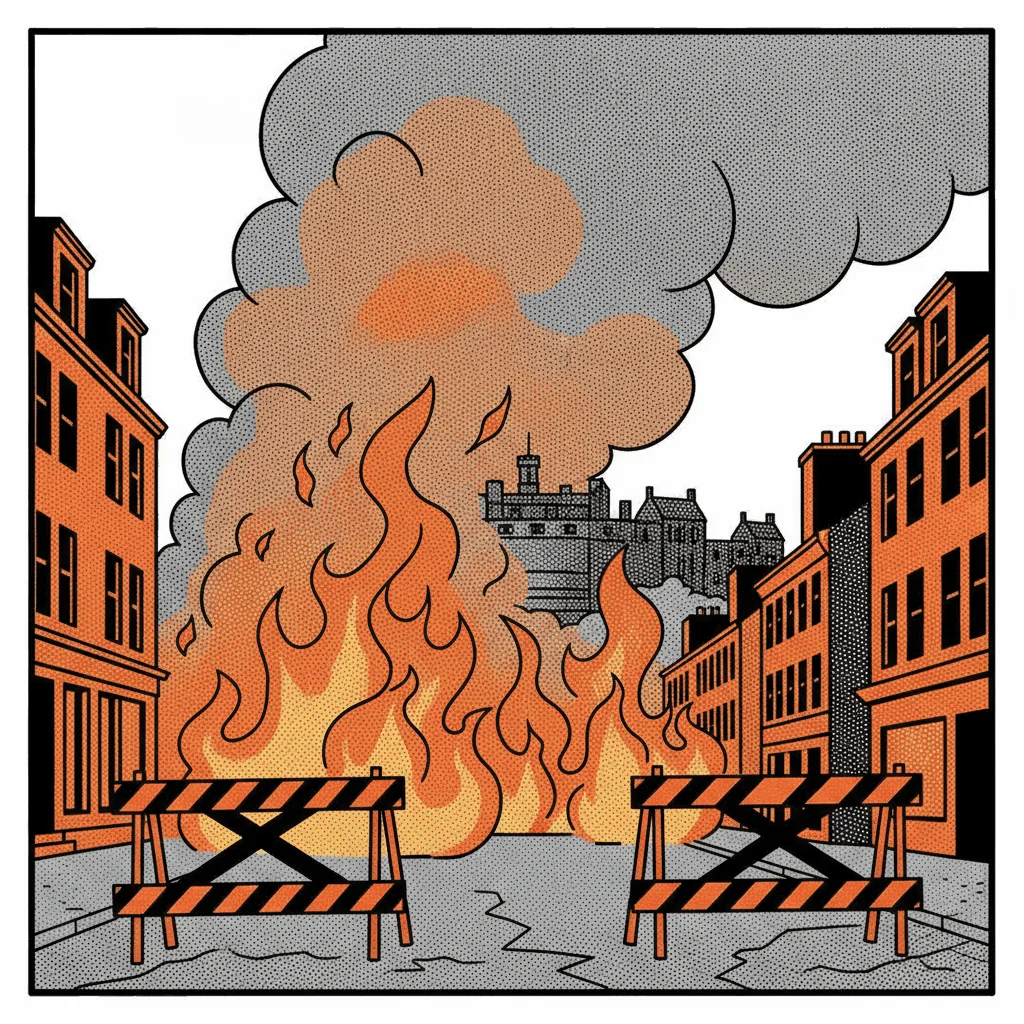
Princes Street is Edinburgh's economic spine. Around 17 million visitors pass through the city each year, according to VisitScotland figures, and a significant proportion of that foot traffic moves along or across Princes Street. A sustained closure, with no confirmed reopening timeline, is not a minor inconvenience. For businesses whose entire commercial model is built around that footfall, it is an existential pressure arriving at precisely the wrong moment.
The fire, which caused serious structural damage to a building on the street, has prompted an indefinite cordon that forces pedestrians and vehicles to reroute. That rerouting matters enormously in practice. Retailers, cafés, and hospitality venues that depend on passing trade, not destination customers, are reporting sharp drops in walk-in business. Footfall is not something you can easily recover through marketing. If people cannot physically reach you, they do not come in.
The timing compounds the problem. Edinburgh's visitor economy is acutely seasonal. The Scottish Retail Consortium has consistently noted that Edinburgh city centre trades heavily on a concentrated window from May through August, with the Festival period alone accounting for a disproportionate share of annual revenue for many operators. A closure running through that window, with no confirmed resolution, forces businesses to make decisions about staffing, stock, and cash flow under conditions of genuine uncertainty. Most small operators do not carry reserves large enough to absorb weeks of suppressed revenue.
What is missing from the current situation is any formal mechanism to support affected businesses. Business interruption insurance typically requires a specific insured peril tied to the policyholder's own premises. A closure caused by a neighbouring building's structural damage often falls into a grey area that insurers dispute. The Federation of Small Businesses has previously flagged this gap following similar cordon situations in Scottish city centres, noting that many SME policies simply do not cover event-driven footfall loss at this remove. Owners should check their policies now, and check specifically for denial-of-access or loss-of-attraction clauses.
Edinburgh City Council and City of Edinburgh's economic development teams have tools available to support businesses in genuine distress, including hardship funds and rate relief mechanisms that can be activated in exceptional circumstances. The Scottish Government's business support infrastructure, including Business Gateway Edinburgh, also offers emergency advisory support. The onus is on business owners to make contact proactively. These schemes rarely find businesses. Businesses have to find them. If you are trading on or immediately adjacent to the affected stretch, that call is worth making this week, not next month.