

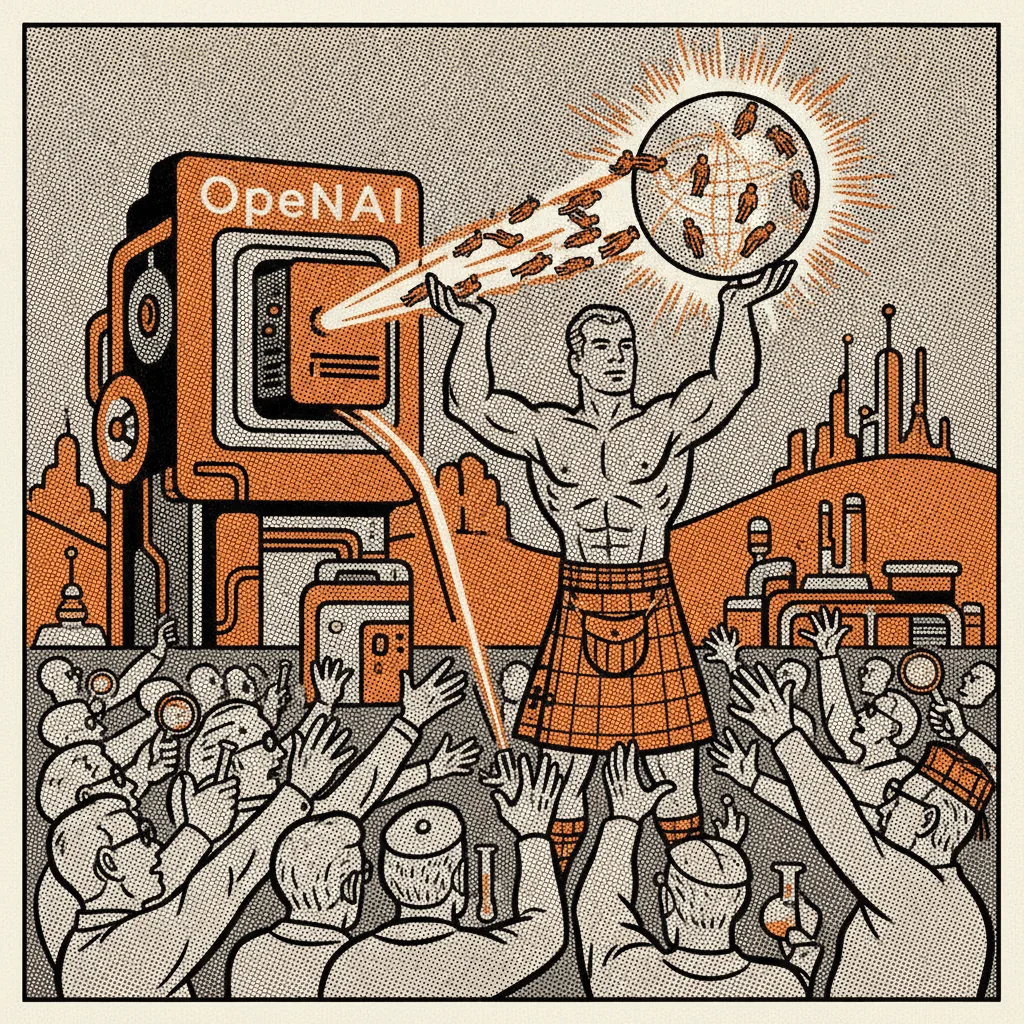
OpenAI announced this week that it will give 100,000 academic researchers free access to its frontier AI models through 2027, via a programme called ChatGPT for Academic Researchers. The rollout begins with 10,000 users this summer and scales from there. For researchers at Edinburgh, Glasgow, St Andrews, Dundee, and Aberdeen, this is not a future opportunity. It is available now, and the application window is open.
The programme covers access to OpenAI's most capable models, the kind that carry serious token costs in commercial settings. For an NHS researcher running literature reviews, synthesising clinical trial data, or drafting grant applications, the value is immediate. According to the UK Research and Innovation (UKRI) body, grant application and reporting processes alone absorb a disproportionate share of researcher time, time that could go towards the actual science. Free frontier AI cuts directly into that overhead.
It is worth understanding why OpenAI can afford the gesture. The same week, the company announced a significant reduction in the cost of its API token pricing, driven by infrastructure efficiencies from its latest model architecture. Cheaper compute means free researcher access is not philanthropy at a loss; it is a considered move to embed OpenAI's tools into the institutions that train the next generation of professionals. According to reporting by Axios, the academic programme is explicitly designed to build long-term familiarity with OpenAI's ecosystem among the people who will shape how AI is used in research, medicine, and public policy.
For Scotland specifically, the opportunity maps neatly onto existing priorities. The Scottish Government's AI Strategy, published in 2021 and updated since, identifies research and public services as two sectors where AI adoption should accelerate. Scotland's university sector punches well above its population size in research output; the University of Edinburgh alone ranks consistently among Europe's top research institutions. Pairing that research capacity with free access to frontier models is precisely the kind of low-cost, high-impact move the strategy envisages, and it requires no new public spending to activate.
NHS Scotland researchers are equally well-placed. Clinical research teams working on everything from cancer pathology to mental health outcomes spend significant hours on systematic reviews, data summarisation, and regulatory documentation. A 2023 report from the Health Foundation found that NHS researchers in the UK spend, on average, more time on administrative tasks than on primary research activities. Free AI access, applied carefully, addresses that imbalance directly. The caveat, as always, is data governance: patient data must never enter a commercial AI platform without explicit consent and compliant data-sharing agreements. But for open-source literature work, hypothesis generation, and non-patient administrative tasks, the door is wide open.