

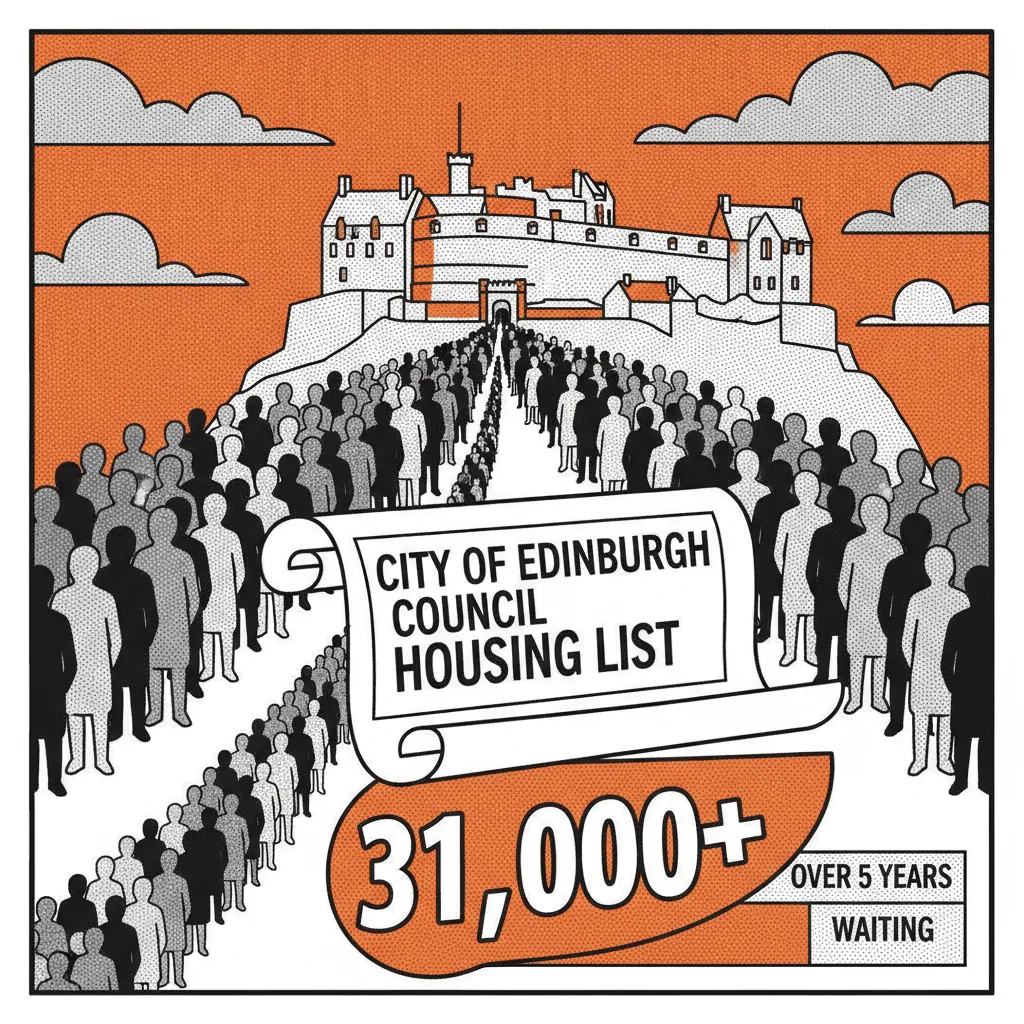
Edinburgh's housing waiting list has hit 31,500 people, according to figures obtained from City of Edinburgh Council under Freedom of Information law. Of those, almost a third, roughly 10,000 people, have been on that list for more than five years. That is not a queue. That is a city failing to house a significant slice of its own workforce.
The practical consequences for Edinburgh businesses are real and underreported. When people cannot find affordable housing in the city, they do not wait patiently, they leave. Research from the Scottish Government's Planning and Architecture Division has consistently linked housing supply constraints to labour market tightening, particularly in cities where private rents have risen sharply. According to Citylets data, the average monthly rent in Edinburgh now sits above £1,400 for a one-bedroom flat, a figure that has risen more than 20 per cent in three years. For anyone earning at or near the median wage, that is not a viable city to build a life in.
For SME owners, this creates a specific and painful problem: you are competing for staff in a city where your candidates simply cannot afford to live. Hospitality, retail, care, education support, and the trades are all sectors where Edinburgh businesses report acute recruitment difficulty. The Scottish Chambers of Commerce quarterly economic survey has flagged labour availability as the single biggest constraint on Scottish SME growth for the past two years running. Housing is a significant and underacknowledged driver of that problem.
City of Edinburgh Council has committed to building 10,000 affordable homes by 2032 under its Housing Capital Programme, and the Scottish Government's Housing to 2040 strategy sets an ambition of 110,000 affordable homes across Scotland over the same period. Those are serious commitments on paper. But 10,000 people have already been waiting five years or more, and construction timelines in Edinburgh, complicated by heritage restrictions, land costs, and planning complexity, mean relief is unlikely to arrive quickly for the people currently on that list.
There is a structural angle here that deserves saying plainly. Edinburgh is one of the most visited, most economically productive, and most internationally recognised cities in Europe. It generates substantial tax revenue and attracts global investment. The fact that it cannot house its own key workers is not inevitable, it is a consequence of decades of underinvestment in social housing, a private rental market that has inflated beyond ordinary wages, and a planning system that has struggled to keep pace with population growth. Scottish SMEs are absorbing the cost of that failure every time a good candidate turns down a job because they cannot find somewhere to live.