

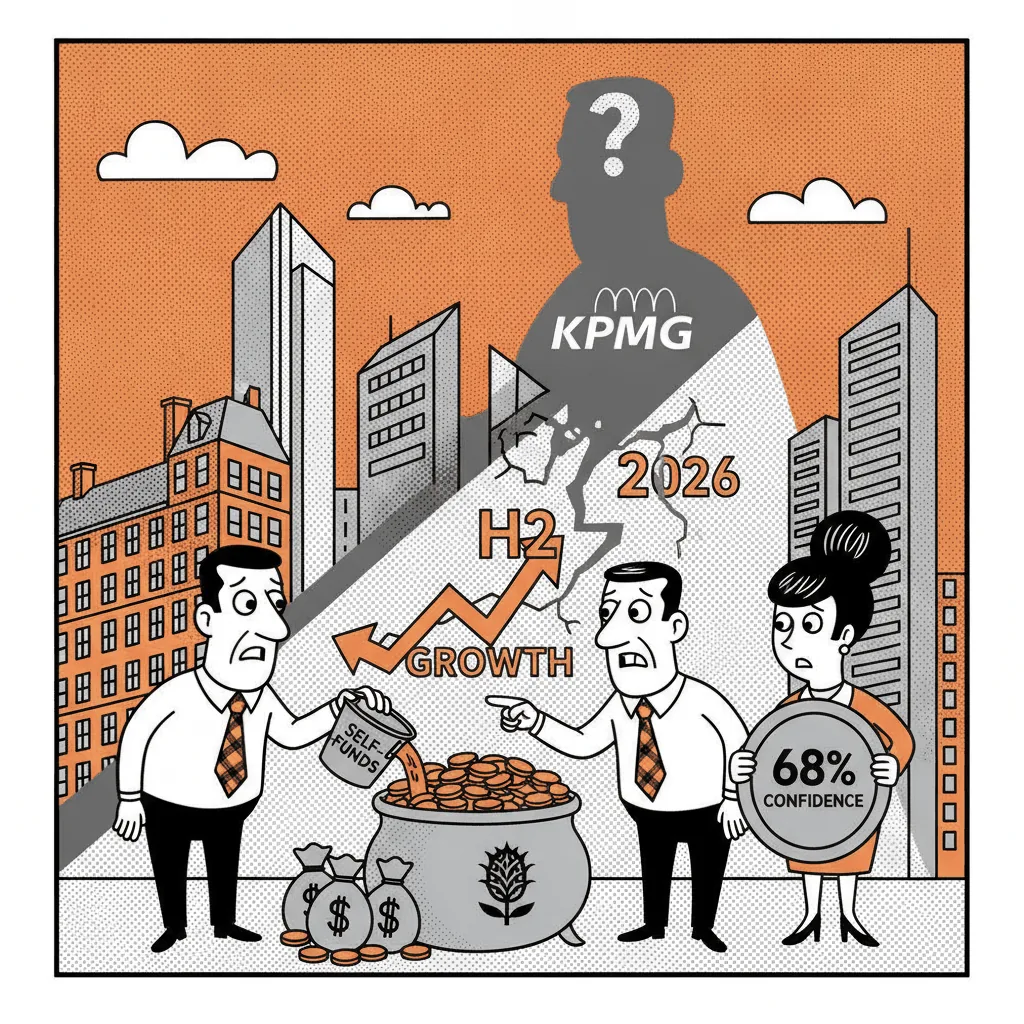
Nearly seven in ten Scottish private business owners, 68% according to KPMG's 2026 Private Enterprise Barometer, say they are confident about delivering growth in the second half of this year. That is a meaningful number. It means the majority of Scottish founders and owner-operators surveyed are not sitting on their hands waiting for conditions to improve. They have a plan.
What they increasingly do not have is external funding to execute it. The same KPMG research, which surveyed 1,500 privately owned UK businesses at the start of 2026, including 119 Scottish firms across professional services, financial services, and technology, found a clear shift toward self-funding as the primary vehicle for growth investment. Retained profits, not bank loans or venture capital, are becoming the engine of Scottish private business expansion.
That shift reflects something structural, not just a blip in sentiment. The Bank of England held rates at elevated levels through much of 2025, and while cuts have followed, business lending has not loosened at anything like the same pace. According to UK Finance data, net lending to small businesses remained broadly flat in early 2026, even as borrowing costs edged down. For many SMEs, the risk premium attached to external debt still does not stack up against the certainty of funding growth from cash they already control.
There is a sharper edge to this story for Scotland specifically. Scottish Enterprise and Business Gateway have consistently reported strong demand for their grant and loan programmes, and the Scottish Government's commitment to SME support remains a genuine differentiator from the UK-wide picture. But public funding mechanisms, however well designed, cannot replace the volume of private capital that tightened credit conditions have withdrawn. The gap between what Scottish businesses want to do and what they can finance externally is real, and it is forcing a discipline that carries both risk and opportunity.
The opportunity is this: businesses that grow on retained earnings tend to grow more deliberately. They make fewer speculative bets, allocate resource more carefully, and often emerge from a tight-finance period with stronger margins and leaner operations. Research from the Federation of Small Businesses has consistently shown that self-funded growth, while slower, produces more durable businesses over a five-year horizon. The risk is equally plain: undercapitalised growth leaves firms exposed to cash flow shocks, and in a market where costs remain elevated, a single bad quarter can unwind months of careful accumulation.
For Scottish SMEs watching this data, the KPMG barometer is less a cause for alarm and more a prompt for honest planning. Confidence is holding. The funding environment is not generous. That combination rewards operators who know their numbers cold, have a clear twelve-month cash position, and are using every available tool, including AI-driven forecasting and financial planning software, to squeeze the most out of what they already have.