

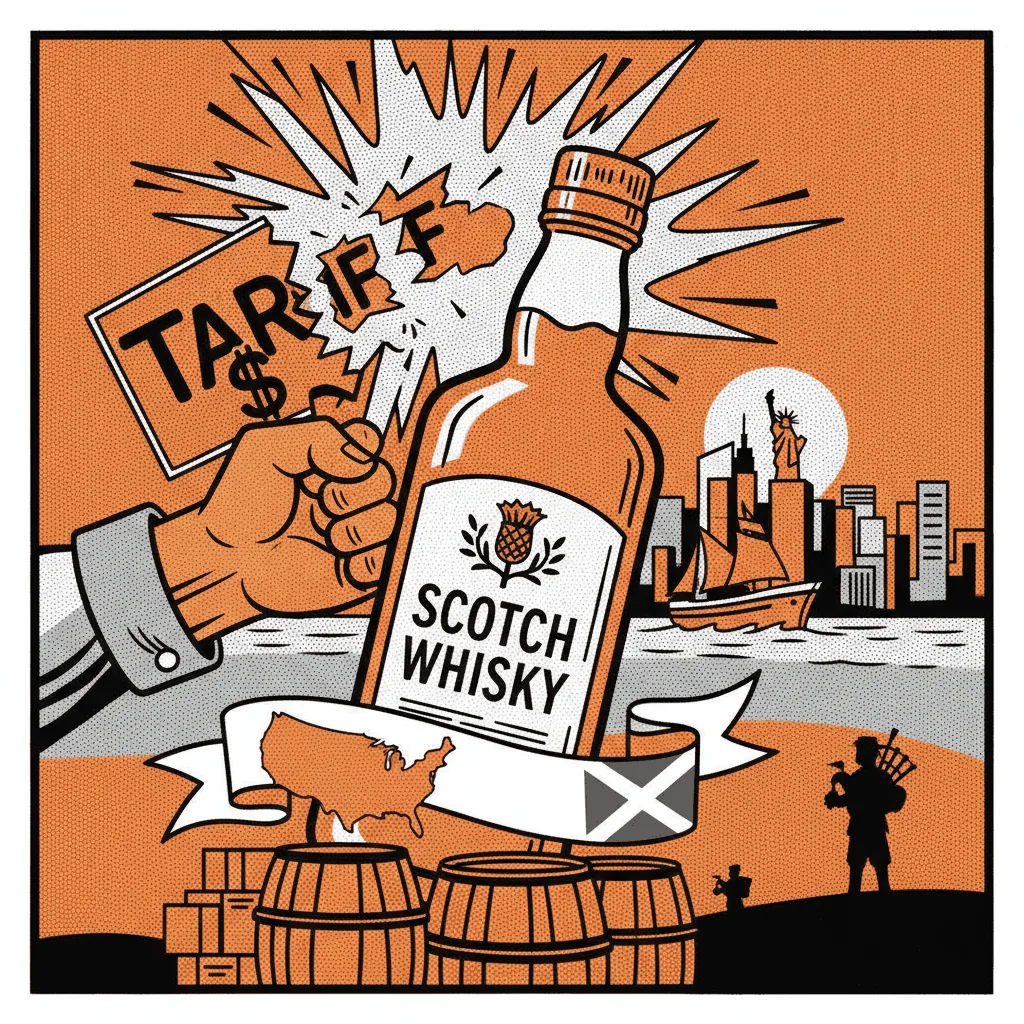
The US has lifted tariffs on Scotch whisky to zero, effective today, in a trade agreement confirmed by the UK Government's Department for Business and Trade. The move ends a dispute that dates back to 2018, when the US imposed 25% tariffs on single malt Scotch as part of a broader Airbus-Boeing subsidy row. That levy cost Scottish producers an estimated £600 million in lost exports over four years, according to the Scotch Whisky Association, making it one of the most damaging trade barriers Scottish industry has faced in a generation.
The numbers behind this sector are hard to ignore. Scotch whisky is Scotland's single largest food and drink export, worth £6.2 billion in 2023 according to HMRC trade data, with the United States consistently its most valuable market. Even during the tariff years, American consumers kept buying; the removal of that 25% levy now means Scottish distillers can either sharpen their pricing, widen their margins, or both. For the independent and craft distilleries that have mushroomed across Scotland in the last decade, including dozens in the Highlands, Speyside, and the islands, this is the difference between a tough export market and a genuinely open one.
The ripple effects reach further than the production floor. Scottish tourism, hospitality, and retail businesses that trade on the whisky brand, whether that is an Edinburgh whisky bar stocking premium single malts, a Speyside distillery running visitor experiences, or an online retailer shipping gift sets to American customers, all operate in the commercial shadow of Scotch's global reputation. When the category is healthier, those businesses are healthier. The Scotch Whisky Association, which lobbied hard for this outcome, called it a transformational moment for the industry and for the rural communities that depend on it.
The Scottish Government has long argued that Scotch whisky tariffs represented a structural injustice imposed on Scotland by decisions made in Washington and negotiated in Westminster, with Scottish producers bearing costs they had no hand in creating. The Scottish Food and Drink Federation noted earlier this year that trade barriers remain one of the primary constraints on Scottish export growth, and that removing them selectively, without a broader UK-US free trade agreement in place, creates an uneven playing field across sectors. That broader deal remains unresolved, but today's move demonstrates what targeted negotiation can achieve when an industry makes enough noise for long enough.
For Scottish SMEs, the immediate question is how quickly the market reprices. US importers and distributors will need time to renegotiate contracts and update shelf pricing, but the commercial pressure to pass on the benefit and grow volume will be real and fast. Scottish producers who have already built US distribution infrastructure are best placed to act. Those who have been waiting out the tariff years before committing to the American market now have a clean entry point.