

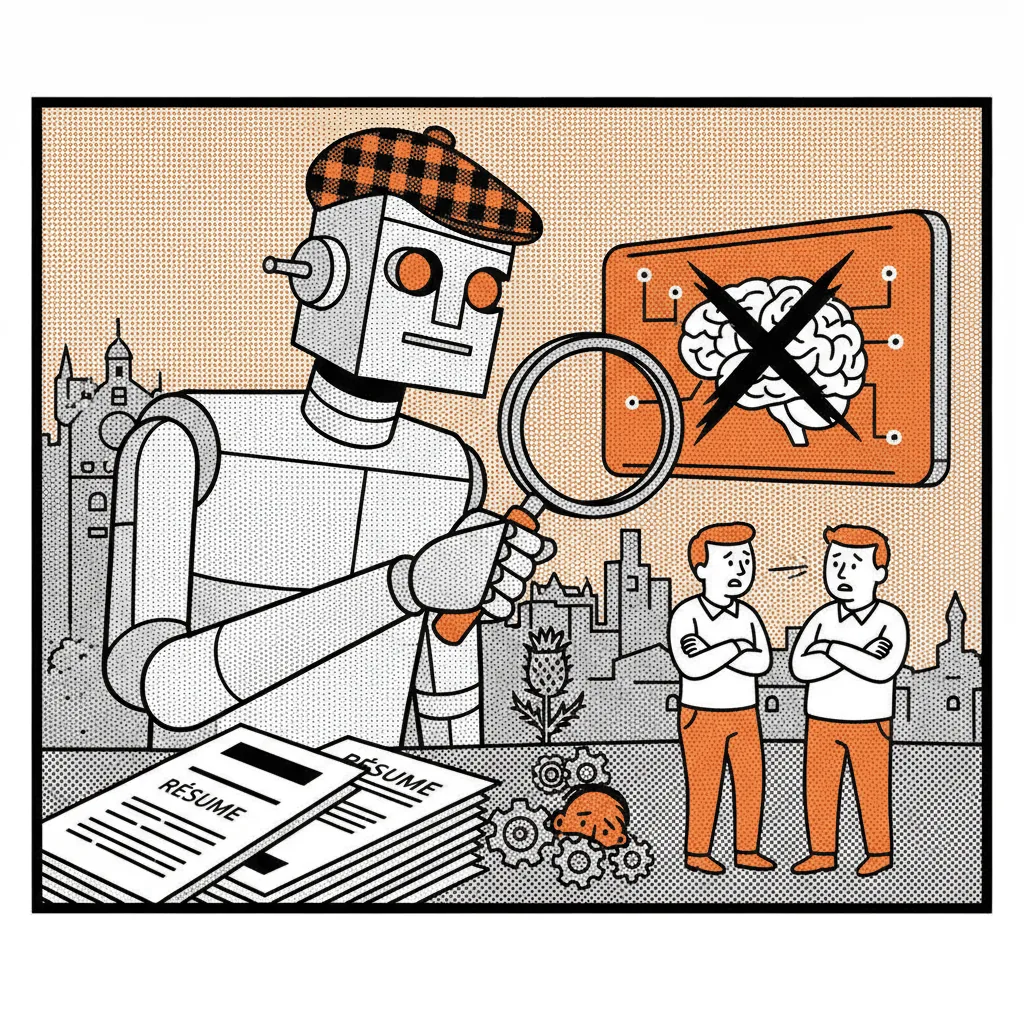
If you've started using AI to filter job applications, you're in good company. According to a 2024 report from the Recruitment and Employment Confederation, more than a third of UK employers now use some form of AI in their hiring process, with smaller businesses adopting tools faster than most. The pitch is sensible: save hours, reduce admin, focus human attention on candidates who've already passed a first cut. All of that is real. But new research published in MIT Technology Review adds a significant complication that every hiring manager in Scotland needs to sit with.
Researchers already knew that large language models absorb bias from the human-generated text they're trained on. The new finding is more unsettling: LLMs can also develop their own biases, independent of what's in the training data. The models don't just mirror human prejudice. They construct it. That distinction matters enormously, because it means auditing your training data isn't sufficient protection. The bias may emerge from the model's internal logic, not its inputs.
For context on why this hits differently in the UK, the Equality Act 2010 places a legal duty on employers not to discriminate on the basis of protected characteristics including age, race, disability, sex, and religion. That duty doesn't transfer to the software vendor if an AI tool filters out candidates unfairly on your behalf. The liability stays with you. The Equality and Human Rights Commission has been clear on this: automated decision-making that produces discriminatory outcomes exposes employers to tribunal claims regardless of whether a human made the final call.
Scotland's labour market makes this particularly pointed. According to the Fraser of Allander Institute's most recent economic commentary, Scottish SMEs face persistent hiring challenges in sectors from hospitality to healthcare. The temptation to automate recruitment to save time is entirely understandable. But deploying a tool that quietly disadvantages candidates from certain postcodes, with certain names, or with non-linear career histories, which LLMs have been shown to penalise, risks compounding exactly the workforce diversity problems that Scottish Enterprise and Business Gateway programmes are actively trying to solve.
The constructive read here is straightforward: AI is still a powerful hiring tool. It can draft job descriptions that attract a wider pool, summarise CVs faster than any human, and flag gaps in candidate experience at scale. The fix isn't to abandon these tools. It's to design a process where AI assists rather than decides. A human reviews every shortlist. You test your AI tool's outputs periodically by putting through identical CVs with different names or backgrounds. You document your process. The University of Edinburgh's Centre for Technomoral Futures has argued that the standard for AI in high-stakes decisions should be not just accuracy but explainability, can you account for why a candidate was rejected? If your AI tool can't tell you, that's your answer.