

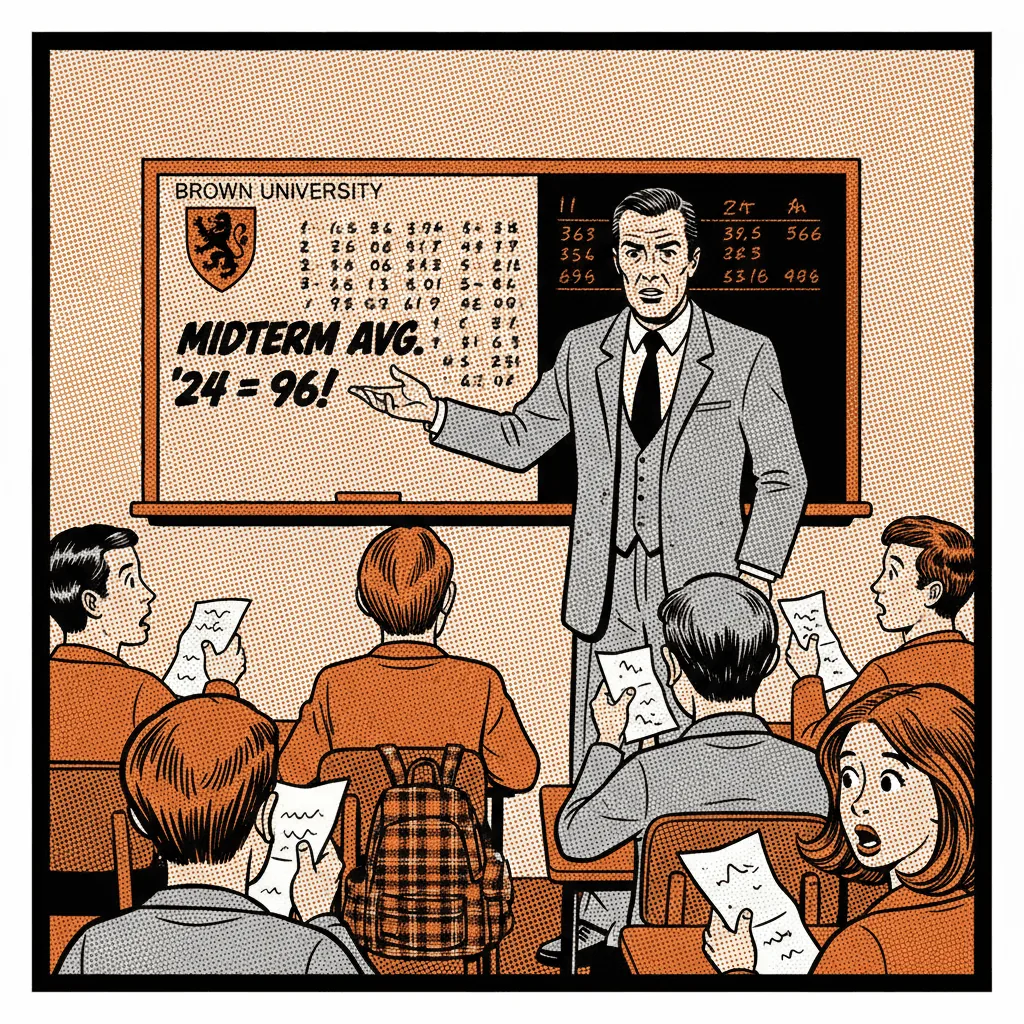
Roberto Serrano teaches economics at Brown University in Rhode Island. When his take-home midterm returned an average of 96 out of 100, he did not celebrate. He got suspicious. He redesigned his final as an in-person, invigilated exam. The average came back at 48. That 48-point gap is now one of the most-cited data points in the global debate about AI and academic integrity, and it deserves a serious read in Scotland.
Serrano has taken the story public, arguing that allowing AI-assisted work to pass as genuine student output does lasting harm. His phrase, reported by The Next Web, is blunt: "We cannot choose to become idiots." The point is not that AI is bad. The point is that if students outsource cognition entirely, they fail to build the underlying capability the qualification is meant to certify. A nurse who passed pharmacology on a chatbot is a different problem from a nurse who understands the drug interactions herself.
The scale of what Serrano documented aligns with broader research. A 2023 survey by the Higher Education Policy Institute found that 53 per cent of UK university students had used generative AI to assist with assessed work, with a significant proportion admitting use that they believed crossed their institution's academic integrity policy. Scotland's universities, from Edinburgh to St Andrews to Strathclyde, are operating in the same environment. According to Quality Assurance Agency Scotland, assessment design is now one of the most urgent challenges facing Scottish higher education. The Brown data gives that urgency a concrete number.
The response from educators matters enormously here, and the wrong response would be a blanket ban. AI tools are not going away, and students who learn to use them well will be more capable professionals. The Scottish Government's AI in Education guidance, published as part of its broader digital learning strategy, acknowledges both the risk and the opportunity. The real design challenge is building assessments that test reasoning, not recall, and that require students to demonstrate understanding they genuinely possess. Oral exams, practical assessments, reflective portfolios, and staged project work all do this better than a take-home essay that can be completed in four minutes by a capable language model.
For Scottish headteachers, university lecturers, and further education managers, the Serrano experiment is actually useful intelligence. It tells you where your current assessment model is vulnerable and what a redesign might need to address. It is not an argument against technology in learning. It is an argument for teaching students to think, and then checking that they can. Those are not contradictory goals. One person with genuine understanding and good AI tools will, over time, massively outperform someone who has only ever had the tools.