

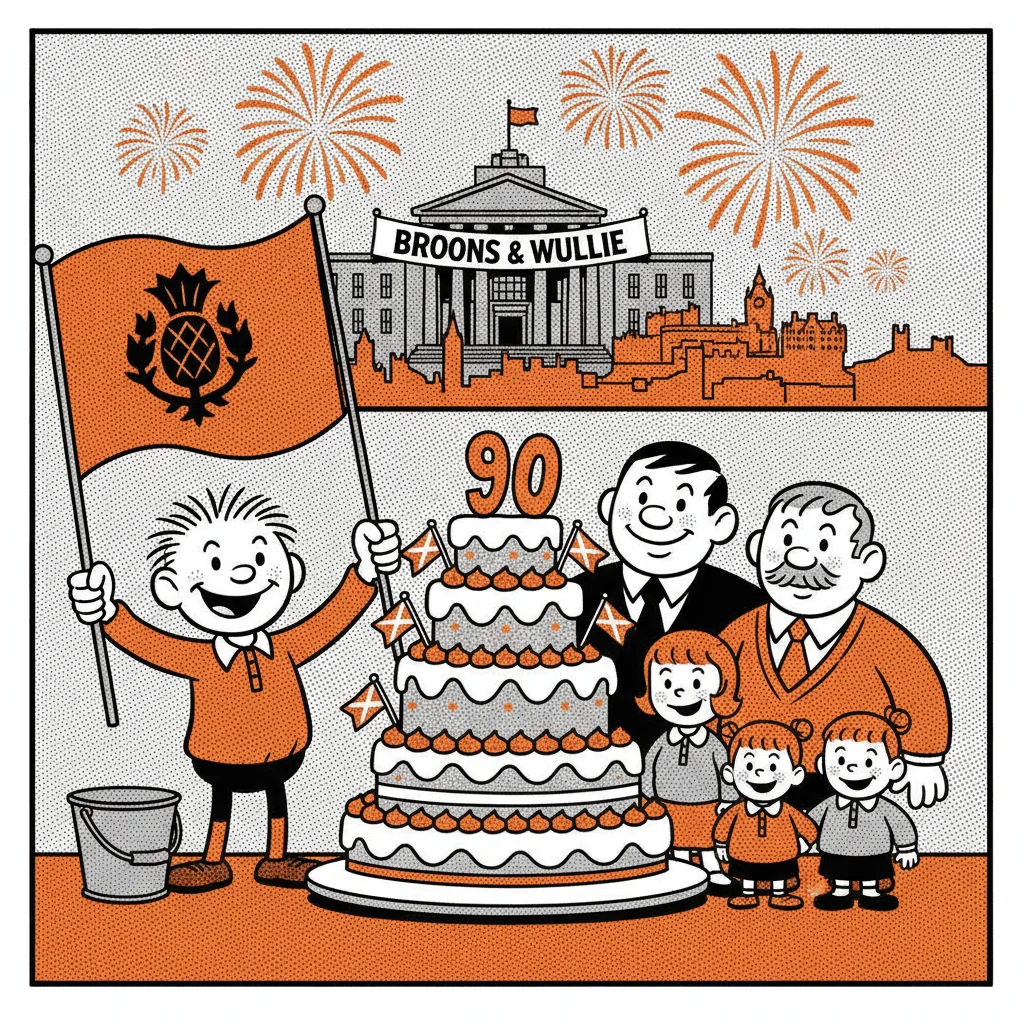
Since 1936, a wee boy on a bucket and a sprawling Dundonian family have told Scotland back to itself, strip by strip, Sunday paper by Sunday paper. Oor Wullie and The Broons both launched in the DC Thomson Sunday Post on 8 March 1936, the same issue, the same day, and ninety years later they are still running. That is not nostalgia. That is institutional.
The National Library of Scotland has partnered with DC Thomson to mark the anniversary with free pop-up events across three cities: Edinburgh, Glasgow, and Dundee, over the weekend of 24 to 26 July. Visitors can expect rare original artwork and archive items that rarely leave the collection, alongside the kind of cultural context that reminds you just how much these two strips absorbed and reflected Scottish working-class life across nearly a century of change.
DC Thomson, the Dundee-based publishing giant behind the Sunday Post, Beano, and Dandy, has quietly been one of Scotland's most durable media businesses. Founded in 1905, it has navigated the collapse of print advertising, the shift to digital, and every media disruption in between, while keeping characters alive that most publishers would have retired decades ago. The Broons and Oor Wullie are now licensed properties with merchandise, touring exhibitions, and international reach, built, entirely, from a Scots dialect newspaper strip.
The National Library of Scotland, which holds one of the most significant collections of Scottish printed material in the world, brings the archival weight to the partnership. Its involvement signals this is not just a commercial anniversary campaign. It is a proper cultural reckoning with what these strips mean: the language, the humour, the gender roles that shifted, the housing that changed, the Scotland that stayed the same underneath all of it.
If you are in Edinburgh, Glasgow, or Dundee that weekend, this is worth an hour of your time. The events are free. The archive material alone is worth the trip, and there is something quietly grounding about being reminded that Scottish storytelling, made in Dundee, loved across the country, still going, does not need London's approval to last ninety years and counting.