

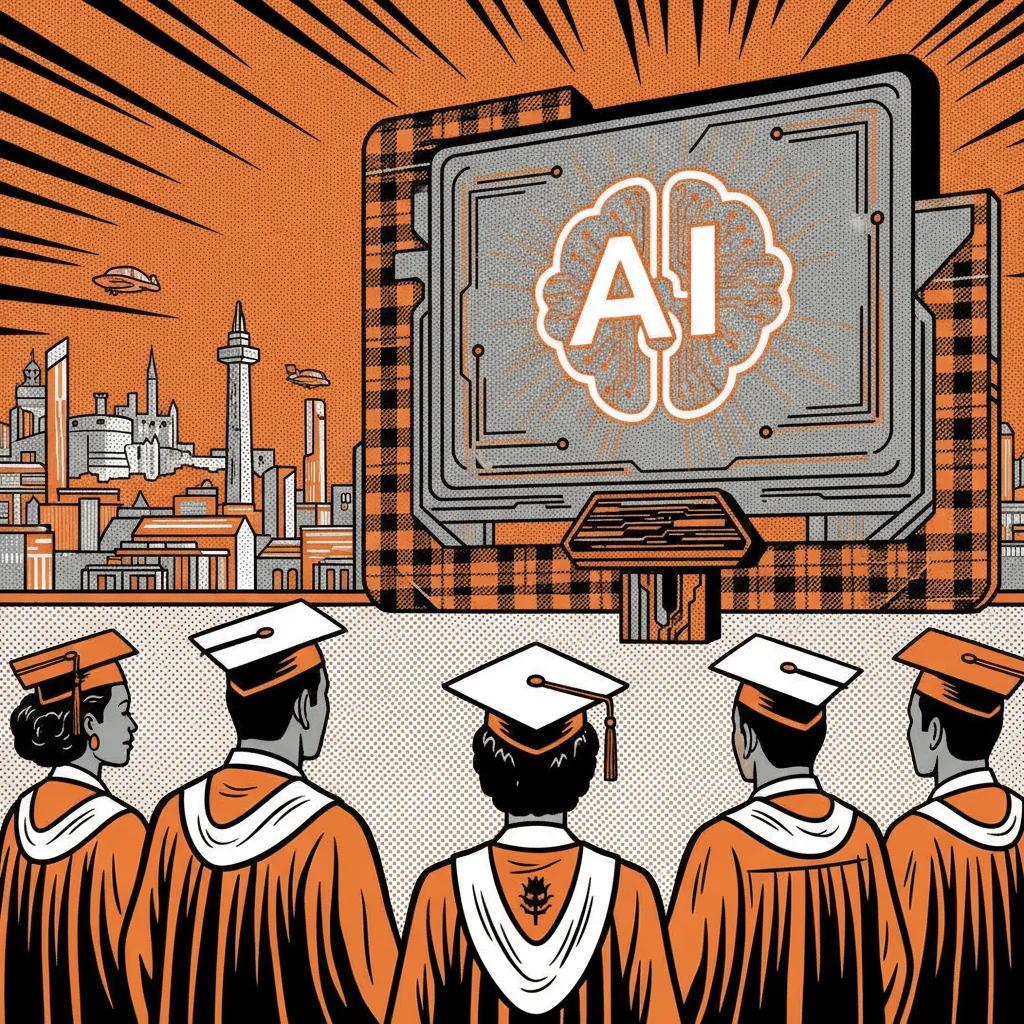
At ISTELive 2026 in Orlando this week, the global education technology organisation ISTE+ASCD unveiled an expanded Profile of an AI-Ready Graduate, a framework that attempts to answer one of the most pressing questions in education right now: what exactly should a school be producing? Joseph South, ISTE+ASCD's chief innovation officer, said the profile emerged from identifying consistent trends across schools, districts, and employers, and the answer is not simply "knows how to use ChatGPT." It is considerably more demanding than that.
The profile centres on a cluster of capabilities: critical evaluation of AI outputs, ethical reasoning about automated decisions, the ability to collaborate with AI tools rather than defer to them, and what South describes as "AI fluency" rather than mere AI literacy. The distinction matters. Literacy is passive. Fluency is productive. A student who is fluent in AI can direct it, interrogate it, and know when to override it. That is the worker Scottish employers will be competing to hire within the decade.
Scotland is not starting from nothing here. The Scottish Government's Digital Learning and Teaching Strategy has been pushing schools toward computational thinking and digital skills since 2016, and Education Scotland has invested in programmes that embed technology across the curriculum rather than treating it as a separate subject. But those frameworks predate the generative AI moment. The question is whether Curriculum for Excellence, already under significant review, can flex quickly enough to absorb what ISTE is describing. According to the Organisation for Economic Co-operation and Development's 2025 Education at a Glance report, countries that embed AI competency frameworks at national curriculum level before 2027 are significantly better positioned for labour market transitions than those that treat it as an add-on.
For Scottish SMEs, this is not an abstract policy question. It is a hiring pipeline question. If you run a practice, a clinic, a consultancy, or a ten-person business in Edinburgh and you plan to recruit in the next three to five years, the skills profile of those graduates is being shaped right now, in classrooms that may or may not be preparing young people to work alongside AI effectively. Research from the University of Strathclyde's Fraser of Allander Institute has consistently shown that Scottish SMEs cite skills gaps as a top constraint on growth. An AI-fluent generation closes several of those gaps at once.
The practical opportunity for Scottish schools and their local business communities is to get ahead of this together. Business Gateway and Scottish Enterprise both run employer engagement programmes that connect companies with schools and colleges. Using those channels to articulate what AI-fluent looks like in a real job, not in a theoretical framework, gives curriculum designers something concrete to work with. The ISTE profile is a solid starting point. What Scotland needs is its own version of it, grounded in what a GP's receptionist, a construction project manager, or a marketing coordinator in an Edinburgh agency actually does with AI on a Tuesday morning.