

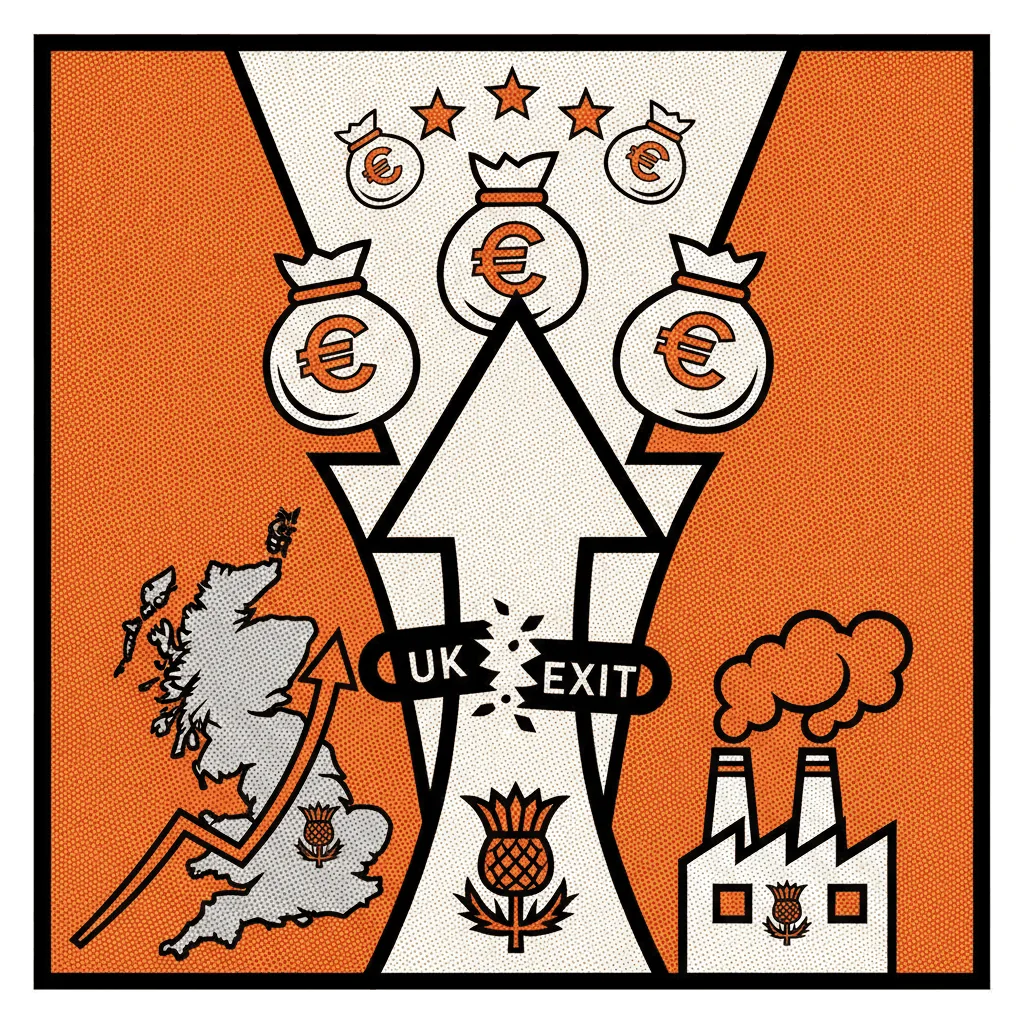
The number comes from a study cited by The Scotsman, modelling the economic impact of full UK re-entry to the European Union. Scotland's share of that uplift lands at £583 million in Gross Value Added, a 0.43 per cent increase on current output. To put that in context, Scotland's total GVA sits at roughly £135 billion according to the Scottish Government's own national accounts data, so this is not a rounding error. It is a structural shift in trading conditions that would ripple into every sector from food and drink to professional services.
The mechanism is not complicated. Brexit introduced friction where there was none: customs declarations, rules-of-origin paperwork, sanitary and phytosanitary checks, and the loss of freedom-of-movement for staff. Each of those frictions carries a cost, and it is disproportionately borne by smaller businesses. A multinational can absorb a compliance team. A ten-person Edinburgh food exporter or a Scottish tech firm billing a Berlin client cannot absorb it quite so cleanly. The Centre for European Reform has consistently found that UK trade with the EU is around 15 per cent lower than it would have been had the UK remained a member, a gap that compounds every year.
Scotland's case is particular. Around 60 per cent of Scotland's international exports go to the EU, according to Scottish Government export statistics, making the bloc far more central to Scottish commercial life than to the UK as a whole. Sectors that anchored that trade, whisky, salmon, financial services, life sciences, have all reported increased friction costs since 2021. Scottish Development International has been working to offset that through trade missions and market diversification, but diversification takes years; restored single market access would take effect immediately upon accession.
The political path is not straightforward, and it is worth being honest about that. Full re-entry requires unanimous approval from existing EU member states, acceptance of the euro as a long-term commitment, and a UK Government willing to reverse its current position. The current Labour administration at Westminster has ruled out re-entry to the single market or customs union in this parliament. That is the immediate ceiling. Scotland cannot re-join independently while it remains part of the UK, which is precisely why this report lands differently here than it does in Swindon. For Scottish independence advocates, the £583 million figure is an argument. For unionist business owners, it is a case for a closer UK-EU relationship short of full membership.
Practical SME strategy cannot wait for a geopolitical resolution that may be a decade away. What the report does usefully is sharpen the question every Scottish exporter or recruiter should already be asking: how much of your current cost base is Brexit friction, and how much of your growth ceiling is a staffing pipeline that closed in 2021? The Fraser of Allander Institute at the University of Strathclyde has been tracking the post-Brexit productivity drag on Scottish firms and the data points in the same direction as this report. The cost is real. The question is whether your pricing, your supplier contracts, and your hiring model reflect it honestly.