

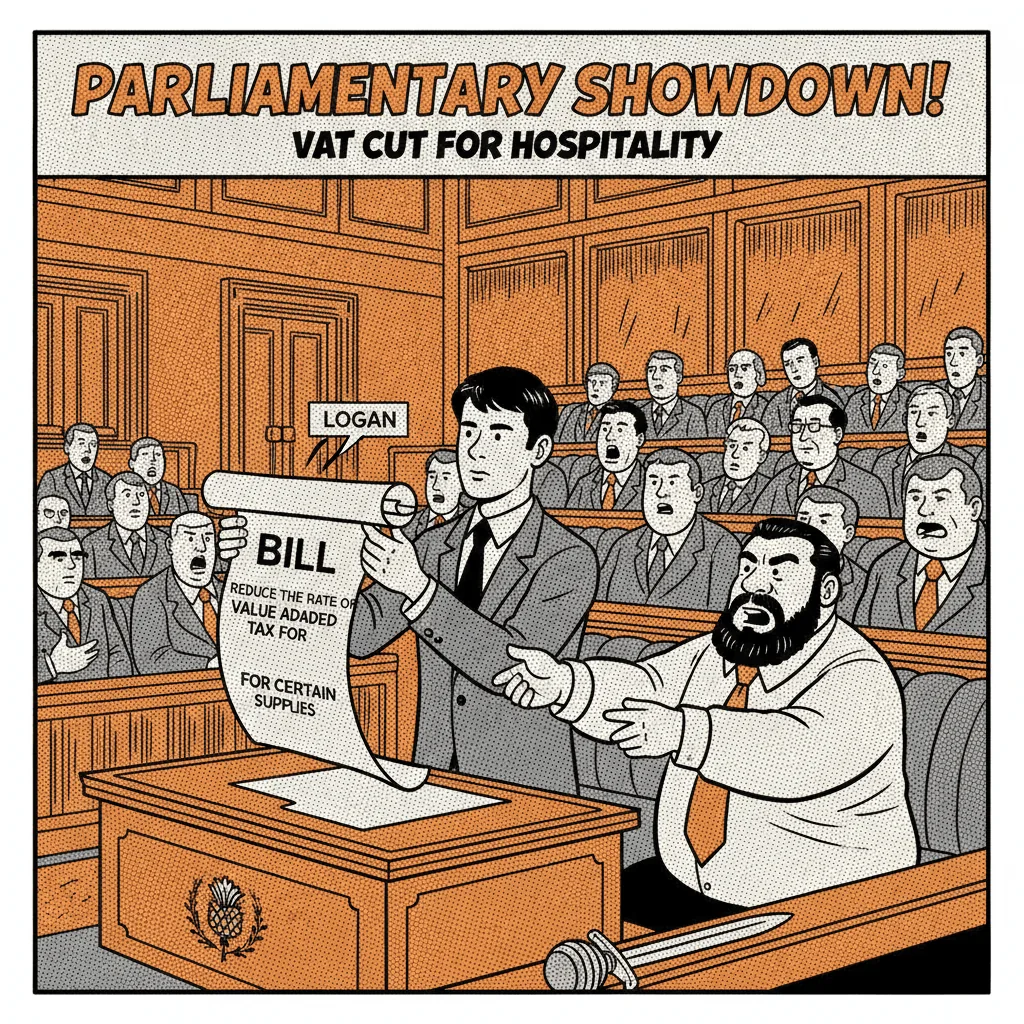
SNP MP Seamus Logan has moved a Presentation Bill in the House of Commons seeking a reduction in VAT for hospitality businesses. The Bill asks the UK Government to cut the rate applied to certain hospitality supplies, food, drink, and accommodation are in scope, and to make that cut permanent, not a temporary pandemic-era measure. It is a signal flare, not yet a law. But it matters.
UK hospitality VAT currently sits at 20%, the same standard rate applied to most goods and services. During the Covid period, the UK Government temporarily reduced it to 5%, then tapered it back up to 12.5% before restoring the full rate in April 2022. UK Hospitality, the sector's main trade body, has consistently argued that restoring a reduced rate, it advocates for 12.5%, would be the single most effective intervention government could make for the sector. The organisation estimates a cut to 12.5% would save the average hospitality business tens of thousands of pounds annually and support over 200,000 jobs across the UK.
For Scotland, the stakes are particularly sharp. According to the Scottish Tourism Alliance, tourism and hospitality together contribute around £12 billion to the Scottish economy each year and support roughly 200,000 jobs. Yet the sector has faced a brutal run: energy costs, the cost-of-living squeeze reducing consumer spending, and rising employer National Insurance contributions introduced in the October 2024 UK Budget have all combined to squeeze margins that were never fat to begin with. The Scottish Licensed Trade Association has repeatedly flagged that pub closures are accelerating, particularly in rural communities where a local pub is often the only social infrastructure that remains.
A Presentation Bill of this kind does not automatically progress through Parliament. It requires government time to advance, which the current UK Government would need to grant. Westminster has so far resisted sector lobbying on VAT, with the Treasury citing the cost to public finances, a reduction to 12.5% across all hospitality is estimated to cost around £4 billion per year in foregone revenue. That is the number opponents reach for. Proponents counter with the economic multiplier: lower VAT means lower prices or higher investment, which drives footfall, which generates more economic activity and more tax overall. The argument is well-rehearsed. What Logan's Bill does is force it back onto the formal record.
Scotland does not control VAT, it remains a reserved matter at Westminster, which is precisely why an SNP MP is pushing this through the Commons rather than Holyrood. The Scottish Government has limited levers here. What it can do, and has done, is lobby for relief and argue the case for devolving hospitality policy more broadly. Whether Westminster listens is a different matter. The track record on that particular ask is not encouraging.