

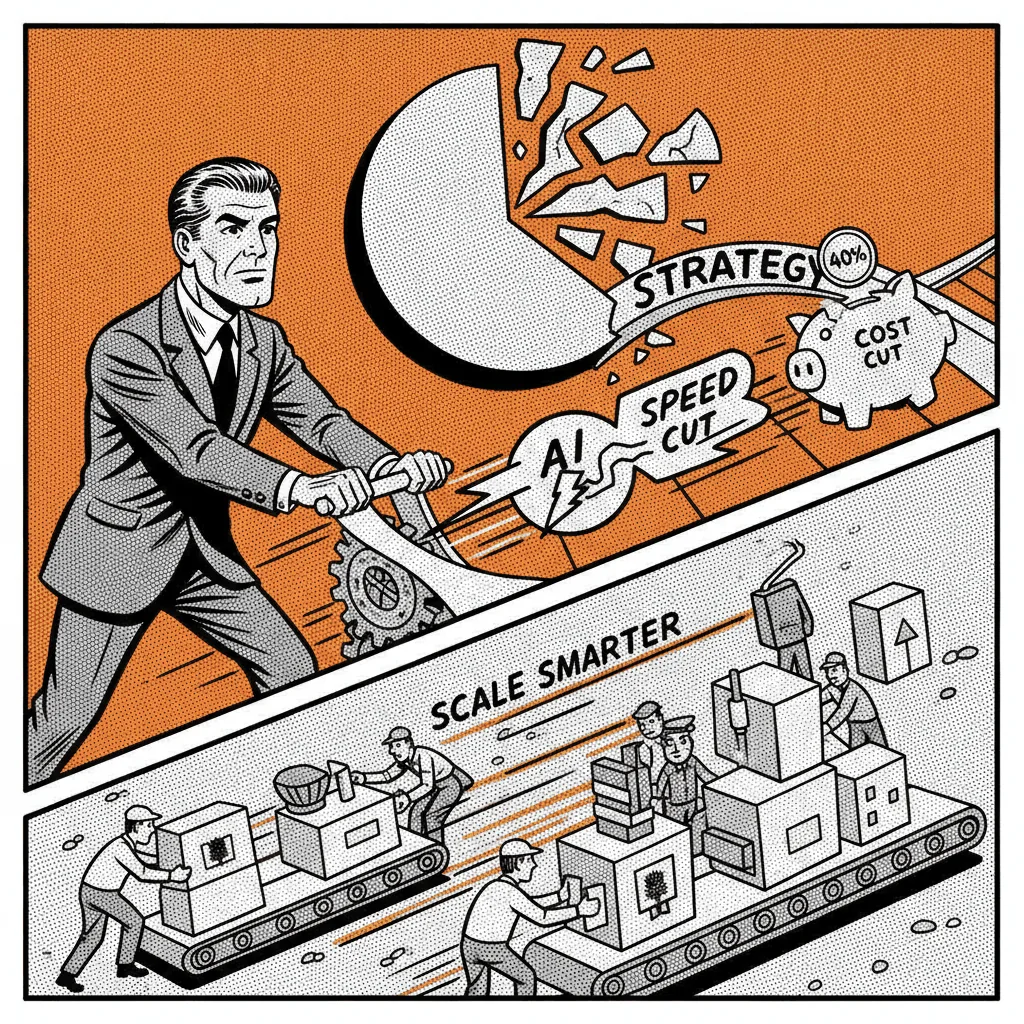
Let's start with the number that matters: custom AI models can now be built 357 times faster than they could just a few years ago. That is not a marginal improvement. That is a category shift. For a Scottish SME owner who previously assumed bespoke AI was the preserve of companies with dedicated data science teams and deep pockets, that gap has closed faster than almost anyone predicted.
But here is the caveat you need to hear before you commission anything. Gartner's research puts the AI project failure rate at 60% by 2026, and the culprit is rarely the model itself. It is the absence of a clear business problem to solve. Founders and managers reach for AI because it feels like the right moment, not because they have identified a specific operational bottleneck that AI is genuinely the best tool to fix. The technology works. The strategy does not.
The entrepreneurs getting results are doing something deceptively simple: they start with a cost or a process, not a technology. According to research from McKinsey's 2024 State of AI report, the highest-value AI use cases for small and mid-sized businesses consistently cluster around three areas, customer-facing automation, internal document processing, and demand forecasting. These are not glamorous. They are repetitive, time-consuming tasks that eat hours and carry real financial cost. That is precisely why automating them compounds so quickly.
For Scottish SMEs, the practical entry point has never been more accessible. Tools like Google's Vertex AI, Microsoft Azure AI Studio, and a growing number of no-code platforms now allow small teams to build and deploy custom models without writing a line of code. Scottish Enterprise's AI advisory support, available through their account management service, can help businesses identify which processes are genuinely worth automating before a penny is spent on development. The University of Edinburgh's Bayes Centre also runs applied AI programmes with direct SME engagement, a resource that remains underused by the businesses that would benefit most.
The businesses pulling ahead right now are not the ones chasing the most sophisticated AI. They are the ones who picked one problem, tested a solution cheaply, measured the result, and scaled what worked. A 357x speed increase in model building means the cost of that first experiment is now negligible. The question is no longer whether you can afford to try AI. The question is whether you are prepared to be honest about what problem you are actually trying to solve.