

Around 13% of Scottish premises still lack access to superfast broadband, according to Ofcom's Connected Nations Scotland report, and in rural areas that figure climbs sharply. For a business in a village like Garlogie, Aberdeenshire, that is not an inconvenience. It is a structural trading disadvantage. Slow uploads mean lost video calls, failed cloud backups, and payment terminals that drop mid-transaction. It means competing with one hand tied behind your back.
The standard answer from government and infrastructure bodies has been to wait for Project Gigabit or the Scottish Government's Reaching 100 programme, known as R100, to lay full fibre to the door. R100 has connected tens of thousands of premises across Scotland and remains a genuinely important commitment. But the Scottish Government's own figures acknowledge that the most remote and hardest-to-reach properties are last in the queue, and last can mean 2026, 2027, or later still. For a business owner trying to make payroll now, that timeline is not acceptable.
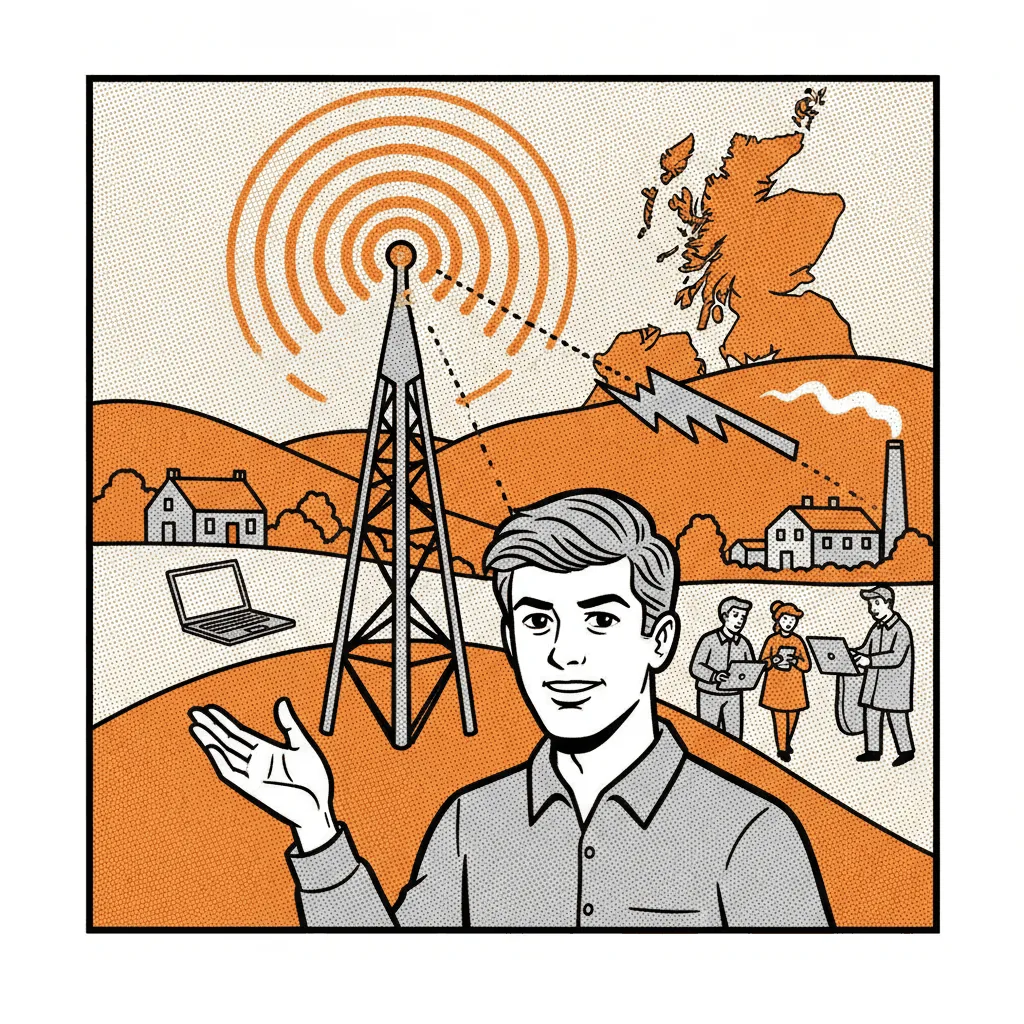
Fixed wireless access, the technology championed by operators like Voneus and others working in Scottish rural markets, changes the calculation. Rather than digging trenches for fibre, a wireless provider installs a receiver at the property and bounces a signal from a local mast, often one already serving nearby homes. Speeds of 100 Mbps or above are achievable, installation takes hours rather than months, and the cost to the end user is comparable to a standard urban broadband contract. Connor Milligan, writing in The Scotsman, points to communities that have gone from near-unusable connections to full business-grade speeds without waiting for a single metre of fibre to be laid.
The business case is direct. According to research by the Federation of Small Businesses, unreliable broadband costs UK small businesses an estimated £11,000 per year in lost productivity, missed opportunities, and workarounds. For a sole trader running an e-commerce operation from rural Perthshire, or a GP practice in the Borders managing remote patient records, that cost is not abstract. It is margin, hours, and in healthcare, patient safety. The FSB has repeatedly called on UK and Scottish governments to treat rural connectivity as critical infrastructure, not a rural amenity.
Scotland is, in many respects, ideally positioned to lead on this. A dispersed population, strong renewable energy infrastructure, and a government with stated ambitions around digital inclusion create the conditions for wireless networks to flourish. Highlands and Islands Enterprise has funded connectivity projects across the region for years, and organisations like Community Broadband Scotland have demonstrated that community-owned wireless networks are viable and sustainable. The tools exist. The technology works. What rural SMEs need is for local authorities, enterprise agencies, and their own trade bodies to make more noise about wireless as a legitimate, bankable solution rather than a stopgap.
There is also a wider story here about what connectivity unlocks. A reliable 100 Mbps connection does not just let you send emails. It lets a rural accountant run cloud accounting software. It lets a Highland distillery manage international wholesale orders in real time. It lets a remote school deliver hybrid learning. Broadband is not infrastructure for its own sake. It is the precondition for every other digital tool, AI platform, and productivity gain that urban businesses already take for granted.