

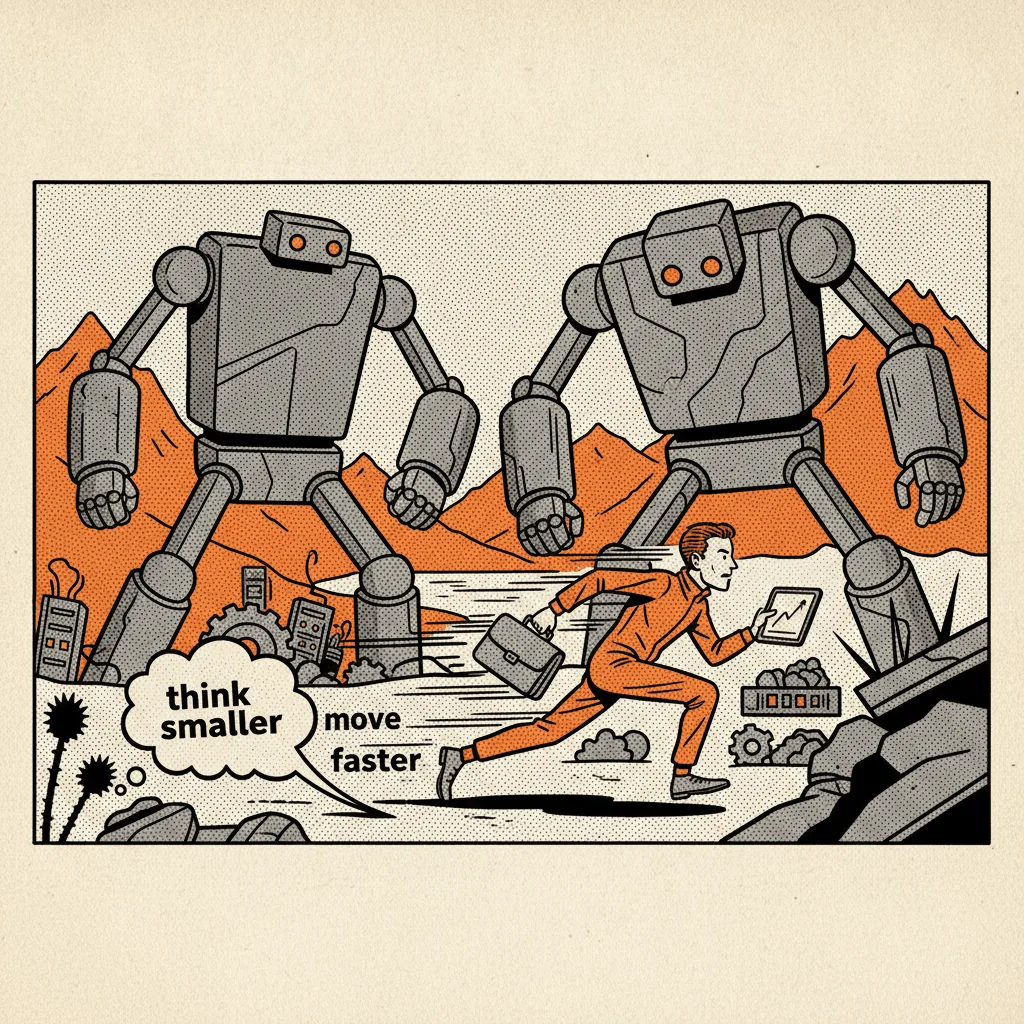
For the first time in business history, a single person with a laptop and a decent broadband connection can run marketing, operations, customer service, content production, financial analysis, and product development simultaneously, without hiring anyone. This is not a prediction. It is happening now, and the evidence is stacking up. According to the Office for National Statistics, sole trader businesses account for roughly 56% of all private sector businesses in the UK. What changes with AI is not the number of solo founders; it is what each of them can now do.
The core advantage that large companies have always held is resource depth: more people, more specialist knowledge, more hours in the working day. AI erodes all three. Tools like Claude, ChatGPT, Perplexity, and a dozen category-specific applications now let a solo operator run paid ad copy, draft client proposals, analyse competitor pricing, and produce a weekly newsletter before lunch. Research published by McKinsey Global Institute estimated that generative AI could automate up to 70% of tasks currently handled by knowledge workers. For a solo founder, that is not a threat, it is a full-time employee they never have to manage.
The strategic shift matters as much as the tooling. Large organisations are slow. They have approval chains, brand committees, quarterly planning cycles, and a structural inability to pivot without a meeting. A solo founder using AI can test a new product idea, build a landing page, run a small ad campaign, read the results, and kill or scale the idea inside a week. That speed is not just convenient; it is a genuine competitive weapon. Entrepreneur.com, covering this trend, describes it as founders "playing a different game" rather than trying to out-resource companies that will always have more resource.
For Scottish SME owners, the geography matters too. Scotland's business support infrastructure, Scottish Enterprise, Business Gateway, and Highlands and Islands Enterprise, has been pushing digital adoption hard, with grant funding available specifically to help small businesses integrate new technology. The Scottish Government's Digital Strategy for Scotland sets out a clear ambition to make Scotland a digitally competitive nation, and AI adoption by SMEs is central to that. If you are a Scottish sole trader or small team and you have not explored the Digital Development Loan or the Digital Boost support programme via Business Gateway, you are leaving money and mentorship on the table.
The practical reality is this: a well-configured AI workflow can replace the work of a part-time marketing assistant, a junior copywriter, and a data analyst, all without a contract, a pension contribution, or a line manager. That is not ruthlessness; it is arithmetic. For a solo operator in Edinburgh running a consultancy, a clinic, a design studio, or a trade business, every hour reclaimed from admin is an hour that goes back into client work, product development, or just finishing at a reasonable time. The founders who thrive in the next five years will not necessarily be the ones with the most funding. They will be the ones who figured out, early, that one person with the right tools can move faster than a team without them.