

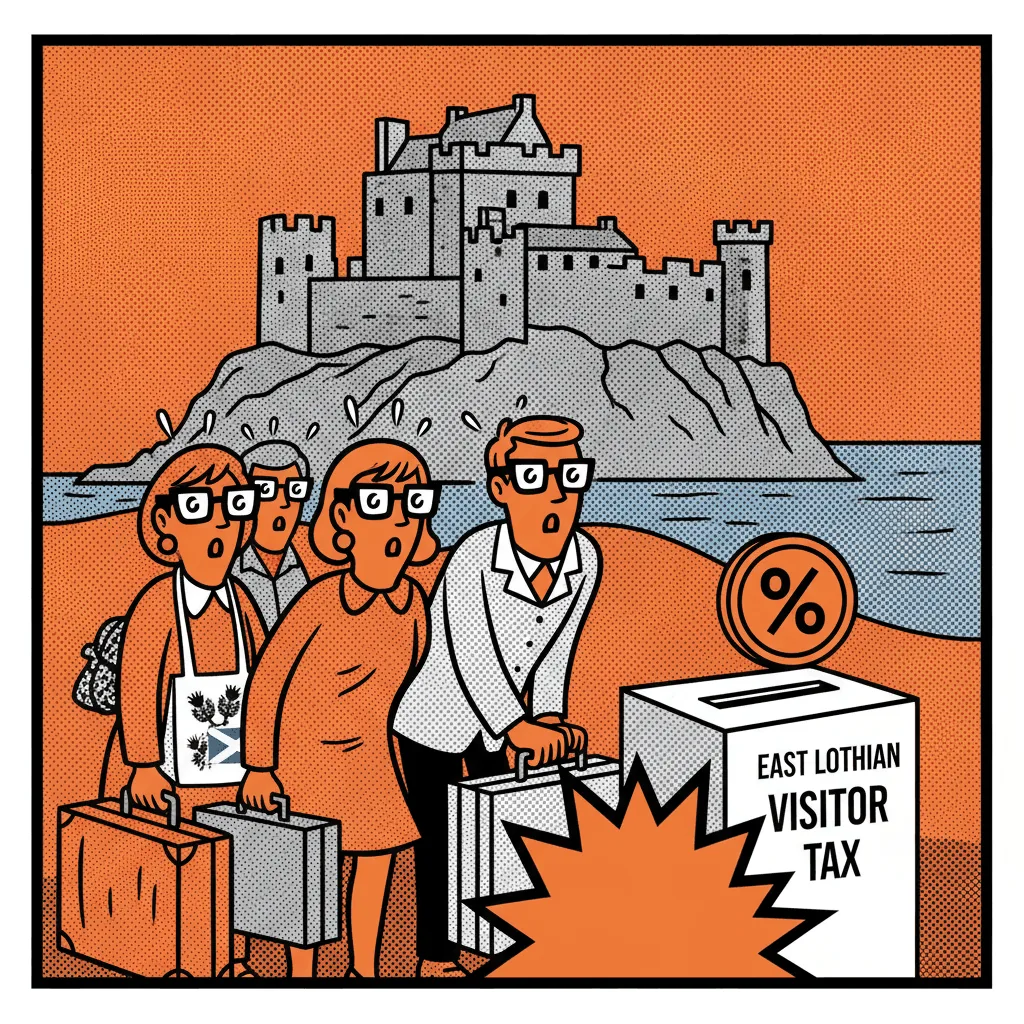
East Lothian Council is exploring a 5% visitor levy on overnight stays, a move projected to raise £1.2 million per year for the local authority. The proposal follows the passage of the Visitor Levy (Scotland) Act 2024, which handed Scottish councils the legal power to introduce such charges for the first time. Edinburgh has already committed to launching its own levy, set at 5% and capped at £3 per night, from July 2026. East Lothian moving in the same direction is less a surprise than a confirmation of the regional pattern.
The Scottish Government's legislation was designed explicitly to give councils a new revenue stream to fund tourism infrastructure: the roads, waste services, public spaces, and cultural assets that visitors use and locals maintain. According to the Scottish Parliament's Financial Memorandum on the Visitor Levy Bill, the policy draws directly on established models in European cities including Amsterdam, Barcelona, and Berlin, where visitor taxes are normalised, built into booking platforms, and largely invisible to guests at point of sale. That normalisation is the policy argument. The commercial reality for operators is more immediate.
For a B&B charging £100 a night in North Berwick or Dunbar, a 5% levy adds £5 to the guest's bill. Passed on cleanly, that is manageable. The pressure comes when operators absorb the cost rather than pass it through, fearing lost bookings to competitors who haven't yet adopted the charge or to self-catering platforms where enforcement has historically been uneven. VisitScotland's own research has consistently shown that price sensitivity among domestic short-break visitors is higher than among international tourists, meaning the levy's impact will not fall equally across all accommodation types or markets.
The timing matters. East Lothian saw significant visitor growth post-pandemic, driven in part by the rise of golf tourism, coastal short breaks, and the overspill from Edinburgh's saturated accommodation market. According to East Lothian Council's own economic data, tourism contributes over £300 million annually to the local economy. A £1.2 million levy return represents less than half a percent of that figure, which is modest at the macro level but concentrated entirely within the accommodation sector at the micro level.
What operators need to watch now is the consultation process and the proposed implementation timeline. Edinburgh's July 2026 start date gives a useful benchmark. If East Lothian aligns with that date, accommodation businesses across the region would face simultaneous levy introduction, creating a cleaner market where the charge becomes standard rather than a competitive variable. The alternative, a staggered rollout, creates the messy middle period where one side of the city boundary charges and the other doesn't, and guests notice. SMEs operating across both council areas, or considering expansion, need to factor this into margin planning and booking platform configuration well ahead of any go-live date.